Table of Contents
The search landscape is undergoing its most significant transformation since the introduction of mobile-first indexing. With AI-generated overviews now appearing at the top of search results, marketers must adapt their strategies to ensure their content remains visible and valuable. Welcome to the era of Generative Engine Optimization (GEO), where preparing your content for AI consumption is becoming as crucial as traditional SEO.
As search engines evolve from information retrieval systems to answer engines powered by large language models, understanding how to optimize for these AI systems has become a competitive necessity. At Hashmeta, we’ve been tracking this shift closely, helping brands across Asia navigate this new terrain where visibility depends not just on keywords and backlinks, but on how effectively your content communicates with generative AI systems.
This comprehensive guide explores what GEO entails, how it differs from traditional SEO, and provides actionable strategies to optimize your content for AI-generated overviews. Whether you’re a seasoned digital marketer or new to the concept of GEO, you’ll learn how to position your content for success in this new paradigm of search.
What is Generative Engine Optimization (GEO)?
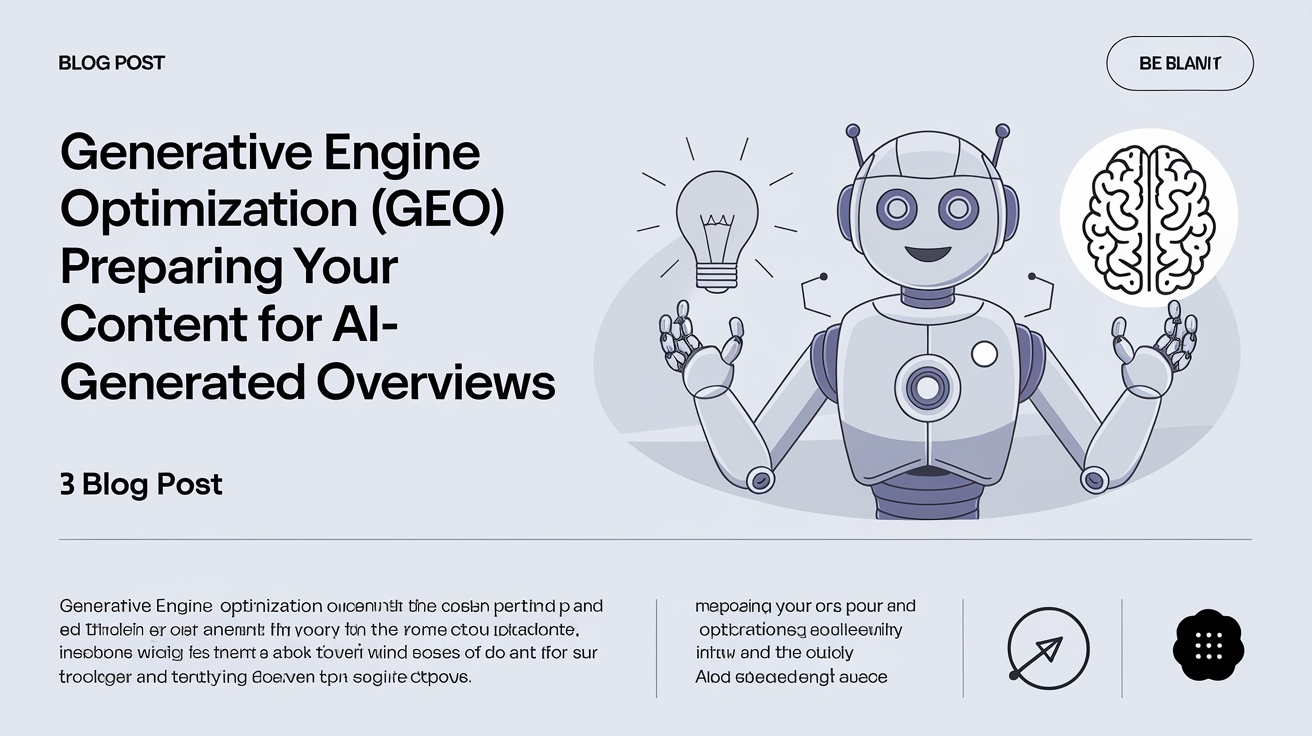
Generative Engine Optimization (GEO) refers to the practice of structuring and creating content specifically to perform well in AI-generated search results, summaries, and overviews. Unlike traditional SEO that focuses primarily on ranking in a list of blue links, GEO aims to ensure your content gets synthesized and featured in AI-generated responses that appear above traditional search results.
The term gained prominence following Google’s introduction of the Search Generative Experience (SGE) and similar AI-powered features from other search engines. These systems use large language models to analyze content across the web and generate concise, direct answers to user queries rather than simply providing links to relevant pages.
At its core, GEO involves optimizing not just for visibility but for extractability – making it easy for AI systems to understand, extract, and synthesize the key information from your content. This represents a fundamental shift in how we approach content creation and optimization in the age of generative AI.
Why GEO Matters Now
As our AI marketing experts have observed, AI-generated overviews are already changing user behavior in significant ways. When presented with a direct answer at the top of search results, users are increasingly less likely to scroll down and click through to individual websites. This means that having your information included in these AI overviews is becoming essential for maintaining visibility.
For brands, the stakes are high. Being excluded from AI-generated summaries could significantly reduce visibility and traffic, regardless of how well your page ranks in traditional search results. Conversely, having your content regularly featured in AI overviews can establish your brand as an authoritative source even without direct clicks to your website.
GEO vs. Traditional SEO: Key Differences
While GEO builds upon the foundation of traditional SEO, it involves several distinct considerations that set it apart from conventional optimization practices. Understanding these differences is crucial for adapting your content strategy effectively:
Focus on Precise Information Delivery
Traditional SEO often involves creating comprehensive content that covers a topic from multiple angles to target various related keywords. While this approach remains valuable, GEO puts greater emphasis on clearly answering specific questions and providing easily extractable information. AI systems are looking for content that directly addresses user queries rather than content that merely contains relevant keywords.
Entity-Based Rather Than Keyword-Based
GEO shifts focus from keywords to entities and relationships between concepts. AI systems understand content contextually, recognizing entities (people, places, things, concepts) and how they relate to each other. This means optimizing for semantic understanding rather than just keyword matching – a key distinction from traditional SEO agency approaches.
Structured Content Emphasis
While clear structure has always been an SEO best practice, it becomes absolutely critical for GEO. AI systems better understand and extract information from content with logical hierarchy, clear headings, well-defined lists, tables, and properly formatted data. The more structured your information, the more likely it will be featured accurately in AI-generated summaries.
E-E-A-T Takes Center Stage
Experience, Expertise, Authoritativeness, and Trustworthiness (E-E-A-T) become even more important in GEO than in traditional SEO. AI systems are designed to prioritize reliable information from credible sources, making these quality signals crucial for inclusion in generated overviews.
Understanding AI-Generated Overviews
To optimize effectively for GEO, it’s essential to understand how AI-generated overviews work and what they typically include. These summaries typically appear above traditional search results and synthesize information from multiple sources to provide comprehensive answers to user queries.
Anatomy of an AI Overview
AI overviews generally consist of several key components:
- Direct answer or summary: A concise response to the query, synthesized from multiple sources
- Attributed sources: Links to websites from which information was gathered
- Supporting details: Additional context, examples, or explanations
- Visual elements: Relevant images, charts, or graphs when applicable
- Follow-up questions: Suggested related queries to explore the topic further
Understanding this structure helps in crafting content that aligns with how AI systems present information to users. Our consulting services regularly analyze these patterns to help clients optimize their content accordingly.
How AI Systems Select Sources
AI-powered search systems don’t randomly select sources for their overviews. They prioritize content based on several factors:
Relevance and comprehensiveness: Content that directly answers the query with sufficient depth and context
Authority signals: Content from established sources with strong E-E-A-T signals
Information clarity: Well-structured content that presents information in an easily digestible format
Freshness and accuracy: Up-to-date information that reflects current understanding of the topic
Cross-verification: Information that can be corroborated across multiple reliable sources
Content Optimization Strategies for GEO
With a clear understanding of how AI-generated overviews work, let’s explore specific strategies for optimizing your content for inclusion in these summaries. Our AI SEO specialists have developed these approaches based on extensive testing and analysis.
Answer-First Content Structure
Adopt an inverted pyramid approach to content creation, placing the most direct, concise answers to likely queries at the beginning of each section, followed by supporting details and context. This makes it easier for AI systems to extract key information while maintaining the depth that human readers expect from quality content.
For example, when addressing “what is generative engine optimization,” begin with a clear, direct definition before expanding into examples, applications, and nuances. This approach increases the likelihood of your definition being selected for inclusion in AI overviews.
Clear Information Hierarchy
Implement a logical heading structure that guides both human readers and AI systems through your content. Use descriptive H2 and H3 headings that clearly indicate the information contained in each section. This helps AI systems understand the organization of your content and extract the most relevant portions for specific queries.
Our content marketing teams recommend using question-based headings where appropriate, as they often align directly with user queries and make it clear exactly what information follows.
Fact-Forward Writing Style
Adopt a clear, factual writing style that presents information efficiently. While storytelling and creative writing remain valuable for engaging human readers, ensure that key facts and data points are presented clearly and not buried within narrative flourishes. Consider using bolded text to highlight critical information that should be prioritized in AI summaries.
This balanced approach ensures your content remains engaging for human readers while being optimized for AI extraction – a core principle of effective SEO service in the age of AI.
Strategic Use of Lists and Tables
Structured data formats like lists and tables make information highly extractable for AI systems. When presenting steps, comparisons, features, or statistical data, format this information using appropriate HTML structures rather than embedding it in paragraph text.
For example, a comparison between traditional SEO and GEO would be more AI-friendly as a structured table than as descriptive paragraphs, while maintaining comprehensive information that serves human readers as well.
The Role of Structured Data in GEO
While visible content structure is important, the technical implementation of structured data plays an equally crucial role in GEO. Structured data helps AI systems understand not just what information your content contains, but what that information means in a semantic context.
Schema Markup for AI Readability
Implementing schema markup using vocabularies from Schema.org provides explicit signals to AI systems about the entities, relationships, and types of information your content contains. For GEO purposes, focus on these high-impact schema types:
FAQPage: Marks up question and answer content, making it highly extractable for AI overviews
HowTo: Structures step-by-step processes or instructions in a format AI systems can easily understand
Article/NewsArticle: Provides context about publication date, authorship, and content type
Product: Clearly defines product attributes, specifications, and features
LocalBusiness: Essential for businesses wanting to appear in location-specific AI responses
Our marketing technology team specializes in implementing these schema types to enhance content visibility in AI-generated results.
Data Tables and Structured Lists
Beyond schema markup, ensure that tabular data is properly formatted using semantic HTML table elements rather than visual tables created through CSS or images. Similarly, use appropriate HTML list elements (ul, ol, li) for any list content.
These semantic HTML structures provide clear signals to AI systems about the nature and organization of your content, increasing the likelihood of accurate extraction and representation in AI overviews.
Measuring GEO Performance
Measuring performance in GEO presents unique challenges compared to traditional SEO, as standard metrics like rankings and click-through rates don’t fully capture visibility in AI-generated overviews. Our SEO consultants recommend a multi-faceted approach to tracking GEO success:
Inclusion Tracking
Monitor when and where your content appears in AI-generated overviews. This requires manually searching for key queries relevant to your content and documenting when your information or website is cited as a source. While labor-intensive, this direct observation provides the clearest picture of your GEO performance.
Several emerging tools now offer automated tracking for AI overview inclusion, though these are still developing in terms of accuracy and coverage. Our AI Local Business Discovery platform incorporates some of these tracking capabilities for local businesses.
Attribution Analysis
When your content is included in AI overviews, analyze which portions were extracted and how they were attributed. This can provide insights into what aspects of your content AI systems find most valuable and authoritative, informing future optimization efforts.
Impression-to-Click Analysis
A significant impact of AI overviews is the potential reduction in click-through rates even when content ranks well in traditional results. Compare historical CTR data with current performance to understand how AI overviews may be affecting user behavior for your key queries.
This analysis should inform a holistic strategy that combines traditional SEO metrics with new GEO-specific indicators to provide a complete picture of search performance.
Future Trends in GEO
The field of Generative Engine Optimization is evolving rapidly as AI systems become more sophisticated and their integration into search experiences expands. Based on our work in AI marketing, we anticipate several key developments that will shape the future of GEO:
Multimodal AI Integration
As AI systems evolve beyond text to understand and generate content across multiple formats (images, video, audio), GEO strategies will need to encompass optimization for these multimodal capabilities. This includes providing clear context for visual content and ensuring that information is accessible across different media formats.
Interactive AI Responses
Future AI overviews will likely become more interactive, allowing users to ask follow-up questions or explore topics in greater depth without leaving the search interface. This evolution will place even greater emphasis on comprehensive content that addresses multiple related queries and provides complete context around topics.
Personalized AI Overviews
As AI systems incorporate more personalization, overviews will increasingly be tailored to individual user preferences, search history, and context. This may require content creators to address various perspectives and use cases within their content to remain relevant across personalized experiences.
Our ecosystem services are designed to help brands prepare for these emerging trends, ensuring content strategies remain future-proof in the rapidly evolving search landscape.
Getting Started with GEO
For organizations looking to implement GEO strategies, we recommend a phased approach that builds on existing SEO foundations while adapting to the unique requirements of AI-generated overviews:
Audit Current Content Performance
Begin by assessing how your existing content performs in AI-generated overviews for key queries. Identify which pieces are being included, what information is being extracted, and where gaps exist compared to competitors. This baseline understanding will inform your optimization priorities.
Prioritize High-Impact Pages
Focus initial GEO efforts on high-value content that addresses common queries in your industry. Product pages, key service descriptions, and definitive guides on topics central to your expertise should be optimized first, as these are most likely to be sourced for AI overviews.
Our Xiaohongshu Marketing specialists have found this prioritization approach particularly effective when helping brands appear in AI-generated content discovery features.
Implement Structured Data
Add appropriate schema markup to priority pages based on content type. This technical foundation significantly improves the likelihood of accurate information extraction by AI systems.
Refine Content Structure
Revise priority content to implement answer-first structures, clear information hierarchy, and strategic formatting of key information. This often involves restructuring rather than completely rewriting existing content.
Through our marketing academy, we offer training on these GEO content structuring techniques for content teams looking to develop these skills internally.
Monitor, Test, and Iterate
Implement tracking for AI overview inclusion, monitor performance, and continuously refine your approach based on results. GEO is an evolving field, and success requires ongoing adaptation as AI systems and integration patterns evolve.
For organizations with more advanced needs, our AI Influencer Discovery tools can help identify how industry authorities are being featured in AI-generated content, providing valuable competitive insights.
Conclusion: Embracing the GEO Opportunity
As AI-generated overviews become an increasingly prominent feature of search experiences, Generative Engine Optimization represents both a challenge and an opportunity for brands and content creators. Those who adapt their content strategies to this new paradigm will maintain and potentially increase their visibility, while those who neglect these changes risk diminishing returns from their content investments.
The fundamental principles of valuable, authoritative content remain unchanged, but the technical and structural considerations for how that content is presented have evolved significantly. By implementing the GEO strategies outlined in this guide – from answer-first content structures to comprehensive schema implementation – organizations can position themselves for continued success in an AI-driven search landscape.
At Hashmeta, our integrated approach to marketing services encompasses both traditional SEO excellence and cutting-edge GEO strategies. As AI continues to transform how users discover and consume information online, we remain committed to helping our clients navigate these changes and leverage them for competitive advantage.
The future of search is generative, and the time to prepare your content for this new era is now.
Need Expert Help With Your GEO Strategy?
Hashmeta’s team of AI marketing specialists can help you optimize your content for AI-generated overviews and ensure your brand maintains visibility in the evolving search landscape. From technical implementation to content restructuring, we provide comprehensive solutions tailored to your specific industry and objectives.