Most marketing advice assumes you can buy your way to a baseline. Set a budget, switch on paid search, buy your brand terms, retarget the leaks, then layer organic on top as the efficiency play.
That assumption breaks completely in regulated verticals.
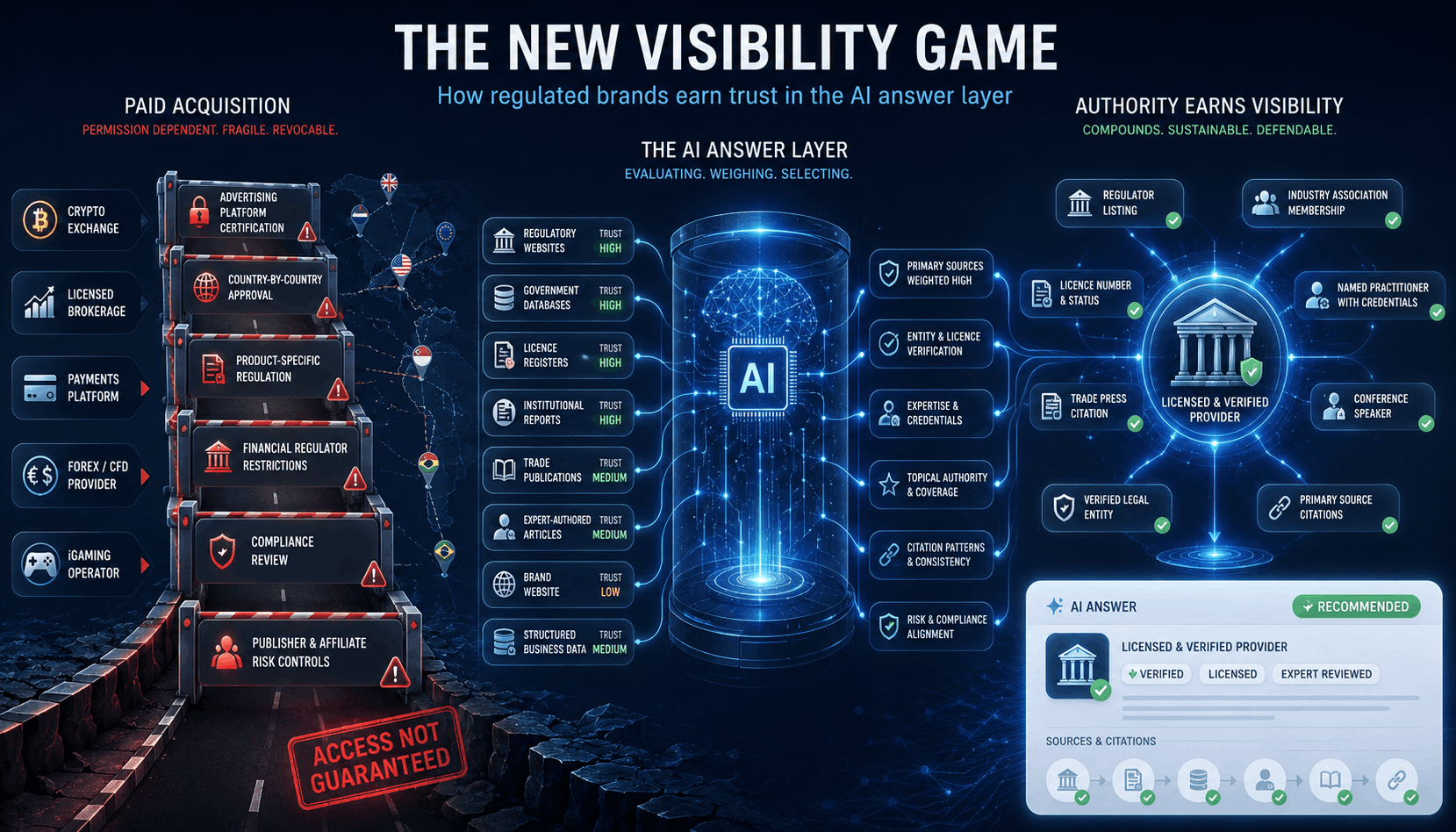
If you run a crypto exchange, a licensed brokerage, a payments business or an iGaming platform, paid acquisition is not a dial you turn. It is a permission you apply for, per product, per country, per domain — and one you can lose without warning. Which means the channel most brands treat as optional insurance becomes the channel you actually live on.
And that channel has changed shape. The question is no longer just “do we rank.” It is “when someone asks an AI engine which provider to use, whose name comes out of the machine.”
This piece is about how that decision gets made in regulated categories, why it works differently than it does for consumer brands, and what a marketing team can realistically do about it.
First, the channel math
Start with why the pressure is asymmetric.
Google permits cryptocurrency advertising only from certified advertisers, and certification is granted narrowly. Exchanges, software and hardware wallets, coin trusts and complex speculative products each sit under separate policy treatment, and approval is scoped to specific countries — clearing one market does not clear the next. Google’s financial products and services policy is revised repeatedly, and each revision resets somebody’s campaign.
The practical effect is multiplicative. An operator running three brand domains across five markets is not managing one certification. It is managing fifteen, each with its own evidentiary pack, each with its own renewal risk, each capable of failing independently.
Gambling advertising is stricter still, with country-level prohibitions that no amount of budget overrides. Forex and CFD promotion is constrained not only by ad platforms but by the financial regulators themselves — several have restricted or banned retail marketing of leveraged products entirely.
Now add the second-order effects. Payment processing is harder to secure. Affiliate networks apply their own risk filters. Some publishers will not accept the category at any price. Mainstream PR is slower to engage.
Stack it up and you get a category where the earned surfaces — organic search, AI answers, third-party citation — are not the efficient channel. They are the load-bearing one.
What actually changed: the answer layer got selective
Here is where it gets interesting, and where a lot of regulated brands are quietly losing ground.
Generative engines do not treat all query categories the same way. Queries touching money, health, legal status and safety fall into what Google’s quality framework calls YMYL — Your Money or Your Life — and the machinery behaves visibly more conservatively there.
Two patterns matter for anyone marketing in a regulated space.
The citation set diverges from the ranking set. Analysis of AI citation behaviour through 2026 found that for complex queries, roughly 38% of cited links come from the top ten organic results for that keyword. In finance, that overlap collapses to around 11%. Read that again: in financial queries, close to nine in ten citations come from somewhere other than the page you fought to rank. Your position-three ranking is not buying you the seat you assumed it was.
Institutional sources get weighted up. Sector analyses have found AI Overviews in YMYL categories are roughly three times more likely to cite government, academic and institutional sources than ordinary blog content. Regulators, supervisory authorities, standards bodies and established trade press absorb the citation share that, in an unregulated category, would go to brand-owned content.
That is not a bug the engines intend to fix. It is a deliberate risk posture. When a wrong answer about a supplement or a leveraged product carries real harm, the system leans on sources it can defend.
So the regulated-industry brand faces a compounding problem. It cannot buy the paid surface. And on the earned surface, the answer layer is structurally biased toward source types it is not.
Four moves that actually shift citation share
The instinct at this point is to publish more. That is the wrong instinct, and in YMYL categories it is actively counterproductive — thin, unsourced volume is precisely the signature the quality systems are built to discount.
What works is narrower and slower.
- Anchor every claim to a primary regulatory source
In a normal category you can assert. In a regulated one, assertion is worthless and citation is everything.
Concretely: when you write that a licensing regime changed, link the regulator’s own statement, name the instrument, date the change. When you cite a capital requirement, cite the rule, not a secondary summary of the rule.
This is not a formatting nicety. It is the thing that makes your page usable to a model that is weighting institutional grounding. A page that already contains the regulator’s language, correctly attributed, is a page an engine can safely draw from — you have done the verification work on its behalf.
There is a corollary most teams miss. It means your content calendar should be driven by the regulatory calendar, not by an editorial cadence. When the EU’s MiCA transitional period ended on 1 July 2026 and firms without authorisation lost the right to serve EU clients, that was not a topic to schedule for next quarter. It was a window measured in days, in which every operator, adviser and counterparty in the market was searching the same set of questions at once.
- Put credentialed humans on the page
The single most reliable YMYL differentiator is a named author with verifiable, relevant credentials — and a page that makes those credentials checkable.
Not “Marketing Team.” Not a byline with no footprint. A named practitioner, with a role, a jurisdiction, a bar admission or regulatory qualification where relevant, and a linked profile that corroborates all of it elsewhere on the open web.
The reason is mechanical: the engine is trying to resolve whether a claim comes from someone accountable for it. An author entity that exists in multiple corroborating places is resolvable. One that exists only on your own domain is not.
- Publish what only you could know
Regulated businesses sit on genuinely scarce information — and systematically fail to publish it.
You know how long an application actually took, versus the published guidance. You know which supervisory questions came back on the second round. You know which banking partners will and will not onboard a newly licensed entity, and what they ask for. You know the difference between what a jurisdiction’s marketing says and what its regulator does.
None of that exists in the training data. All of it is what practitioners are actually searching for.
This is the model GSS Legal runs on its own Insights desk, and it is worth studying as a structure rather than as a content library. The firm publishes short practitioner notes drawn from live licensing files — comparisons like Anjouan versus Curaçao for iGaming, Mauritius FSC versus Labuan FSA for brokerage, what bank de-risking actually looks like for a licensed VASP — and classifies each piece by type: briefing, playbook, or note. Their stated editorial rule is that they publish when there is something substantive to say, not on a schedule.
For a firm that has delivered 812+ licences across 50+ jurisdictions since 2021, the resulting corpus is not commentary. It is operational evidence that nobody outside the practice can reproduce. That is the asset class worth building.
- Build the entity, not just the site
Because citation share in YMYL leans away from brand-owned domains, some of the highest-leverage GEO work in a regulated category happens off your own site entirely.
That means industry association membership that produces a public listing. Regulator registers that carry your entity name — these are high-authority pages, and being correctly and consistently named on them matters. Trade press commentary under a named practitioner. Conference programmes. Structured data that ties your legal entity, licence numbers and trading names together so the machine resolves them as one organisation rather than four loosely related strings.
Consistency is doing more work here than volume. A business operating as one brand name commercially, another on its licence, and a third on its payment descriptor is giving the engines three weak entities instead of one strong one.
What to measure
Regulated marketing teams need a different dashboard, because the usual one will tell them nothing useful for two quarters.
Track these:
- Share of answeron your commercial decision queries — the “best X in Y,” “X vs Y,” “is X licensed in Y” set. Sample consistently across engines and log the cited sources, not just whether you appeared.
- Citation source mix.Where are the engines pulling from in your category? If it is 70% regulator and trade press, your strategy is placement, not publishing.
- Named-entity resolution.Ask the engines directly who your company is, what it is licensed for, and where. Wrong or hedged answers are a concrete, fixable defect.
- Correction latency.When a regulation changes, how long until the answer layer reflects it? This is where fast, well-sourced practitioner content wins outright.
What not to over-weight early: raw traffic. Citation-driven visibility in regulated categories often converts at a fraction of the volume and a multiple of the value, because the person asking an AI engine which licensed provider to use in which jurisdiction is not browsing.
The honest constraints
Three, and none of them are solvable with budget.
Compliance review is the bottleneck. Everything above assumes you can publish substantive claims about regulation. In most regulated firms that means legal sign-off on every asset. Teams that do not restructure this workflow will produce four defensible pieces a year and lose to competitors producing four a month. Fix the process before scaling the output.
It is slow. Entity authority and citation share compound over quarters. If your board expects a channel to switch on in six weeks, this is not that channel — and it is worth saying so before you start rather than after.
You cannot fake the credentials layer. The single fastest way to burn authority in a YMYL category is to publish confident regulatory claims that turn out to be wrong. In this category the downside is not a ranking drop. It is a regulator reading your marketing.
The uncomfortable conclusion
For most consumer brands, generative engine optimisation is an emerging channel worth some experimental budget.
For a licensed operator in crypto, gaming or leveraged trading, it is closer to the whole game — because every other route to the customer is either gated by a platform that can revoke permission, or by a regulator who has already said no.
The brands winning this today are not the ones publishing the most. They are the ones publishing things only a licensed operator could credibly know, under the name of someone accountable for saying it, sourced to the regulator who made the rule.
That is a slower content strategy than most marketing teams are structured to run. In a category where you cannot simply outbid the problem, it is also the only one that compounds.
Hashmeta helps regulated and high-consideration brands across Southeast Asia build search and AI-answer visibility that survives compliance review. Talk to our team about a GEO audit for your category.