- Understanding Hreflang Implementation Challenges
- Laying the Groundwork for Hreflang Automation
- Advanced Automation Tools and Techniques
- Implementing AI-Powered Hreflang Solutions
- Monitoring and Maintaining Hreflang at Scale
- Case Studies: Successful Hreflang Automation
- Common Hreflang Automation Pitfalls and Solutions
For SEO agencies managing multi-lingual websites across diverse markets, implementing hreflang tags correctly isn’t just a technical requirement—it’s a critical factor for international search success. When your client portfolio spans multiple countries with varying language requirements, manual implementation becomes unsustainable and error-prone.
At Hashmeta, our teams across Singapore, Malaysia, Indonesia, and China have navigated the complexities of cross-border SEO for over 1,000 brands. We’ve learned that scaling hreflang implementation requires more than just technical knowledge—it demands systematic automation, continuous monitoring, and region-specific expertise.
This comprehensive guide explores proven strategies for automating hreflang implementation at scale, combining our hands-on experience with cutting-edge AI-powered solutions. Whether you’re managing e-commerce sites across Southeast Asia or content platforms targeting multiple Chinese dialects, these automation approaches will help streamline your international SEO workflows and deliver more consistent results for your clients.
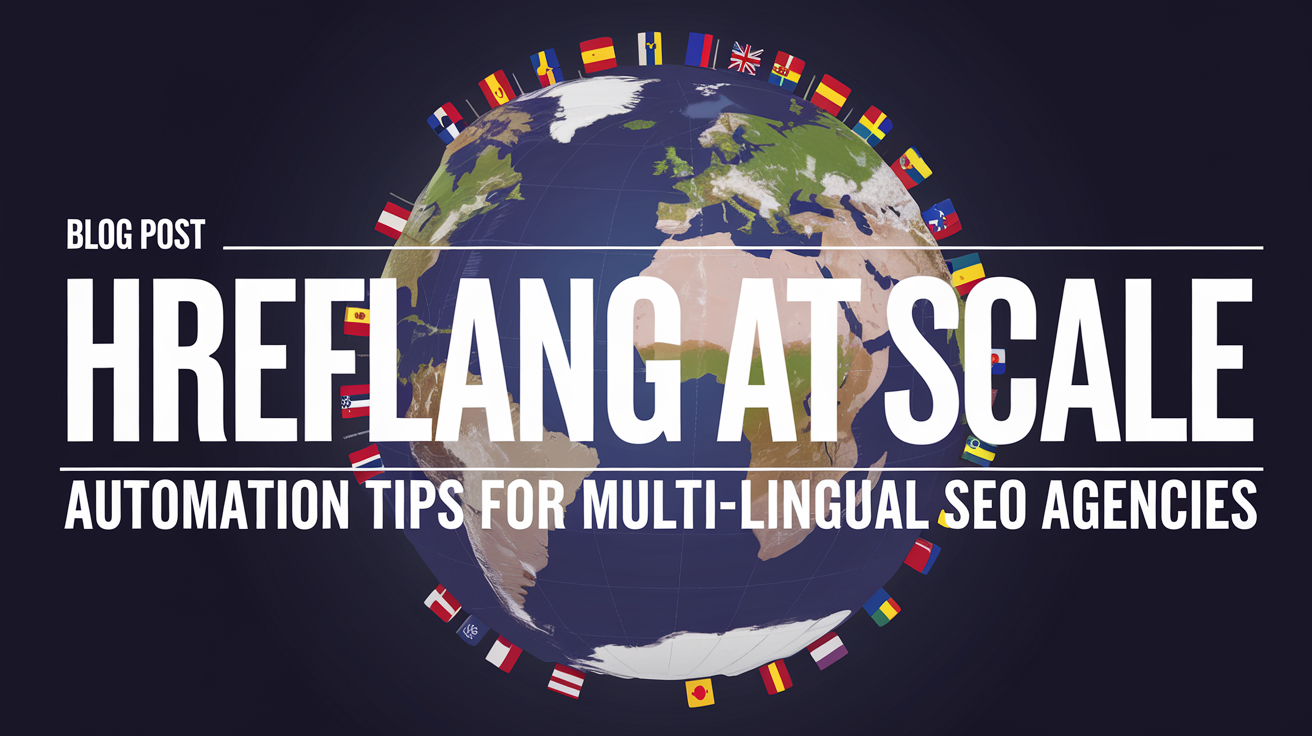
Hreflang Automation at Scale
Best Practices for Multi-Lingual SEO Implementation
The Scale Challenge
For every page with 10 language versions, you need 100 individual hreflang references. A 500-page site in 10 languages requires managing 500,000 references.
Foundation First
Standardize URL structures, create comprehensive content mapping documentation, and establish clear language/region code standards before implementing automation.
Automation Implementation Approaches
CMS Integration
- WordPress plugins (WPML, Polylang)
- Drupal multilingual modules
- Custom CMS extensions
XML Sitemap Automation
- Scheduled generation scripts
- Enterprise SEO platforms
- CI/CD pipeline integration
API-Based Solutions
- Middleware implementation
- CDN-level tag injection
- Dedicated microservices
AI-Powered Hreflang Innovation
Content Matching
Uses semantic analysis to automatically map equivalent content across languages, even with significant variations.
Error Detection
Predicts potential hreflang issues before they impact search performance by identifying inconsistent patterns.
Crawl Optimization
Intelligently prioritizes the most important hreflang signals in sitemaps for optimal search engine processing.
Common Pitfalls to Avoid
- URL Over-Reliance: Don’t depend solely on URL patterns
- Poor Error Handling: Build robust fallback protocols
- Performance Issues: Implement efficient caching
- Testing Gaps: Create representative staging environments
Monitoring Best Practices
- Regular Audits: Schedule automated checks for consistency
- Analytics Integration: Track regional traffic patterns
- Clear Governance: Document implementation decisions
- Validation Processes: Establish pre-deployment checks
Success Metrics
Regional Organic
Traffic Increase
Reduction in Incorrect
Language Sessions
Monthly Hours
Saved
Presented by Hashmeta – Asia’s Performance-Based Digital Marketing Agency
Understanding Hreflang Implementation Challenges
Before diving into automation solutions, it’s essential to understand why hreflang implementation becomes exponentially more complex as website scale increases. The fundamental purpose of hreflang tags is straightforward: they signal to search engines which language and geographic variant of your content should be shown to users in specific regions. However, executing this at scale introduces several challenges:
The Mathematical Complexity Problem
With hreflang implementation, complexity grows exponentially with each new language or country variant. For each page version, you need to reference all other language versions, including self-referencing tags. This creates an n² relationship where adding just one new language version can significantly increase the total number of tags required.
For instance, a relatively modest website with 500 pages translated into 10 languages requires 50,000 pages to be managed. Each of these pages needs hreflang annotations pointing to all language variants, resulting in 500,000 individual hreflang references that must be maintained. When clients expand into new markets or add new language versions, the manual management becomes virtually impossible.
Dynamic Content and Frequent Updates
Many modern websites, particularly e-commerce platforms and content publishers, update their content frequently. Product inventories change, new articles are published, and seasonal content rotates. Each content change potentially affects hreflang relationships, requiring updates across multiple language versions. Without automation, maintaining accuracy becomes a relentless, error-prone task that consumes excessive resources.
Technical Implementation Variations
Hreflang can be implemented in three different ways: HTML head tags, XML sitemaps, or HTTP headers. The optimal approach varies based on website architecture, CMS capabilities, and scale considerations. Many enterprises even use hybrid approaches across different sections of their websites, further complicating maintenance without a centralized, automated system.
Laying the Groundwork for Hreflang Automation
Before implementing automation tools, establishing solid foundations will significantly improve your success rate. Our SEO Agency teams follow these preparation steps:
URL Structure Standardization
Automation becomes far more manageable when URL structures follow consistent patterns across language versions. Ideally, implement one of these approaches:
Subdirectory approach: example.com/en/product and example.com/fr/product
Subdomain approach: en.example.com/product and fr.example.com/product
Country-specific domains: example.com/product and example.fr/product
Whichever structure you choose, consistency is paramount. Avoid mixing approaches unless absolutely necessary due to specific business or technical constraints. With standardized URL patterns, you can create algorithms that automatically generate the correct hreflang references without manual input for each page.
Content Mapping Documentation
Develop a comprehensive mapping system that tracks the relationships between content across different language versions. This should include:
• A master content ID system that remains consistent across all language versions
• Clear documentation of which content exists in which languages
• Handling protocols for content that exists in some languages but not others
• Tracking of regional content variants that may differ significantly from the original
This mapping becomes the source of truth for your automation systems, enabling them to generate accurate hreflang annotations even when content parity isn’t perfect across all languages.
Language and Region Code Standardization
Establish clear standards for language and region code usage. While ISO standards provide the framework (ISO 639-1 for language codes and ISO 3166-1 Alpha 2 for country codes), real-world implementation often requires additional decisions:
• When to use language-only codes (e.g., “en”) versus language-region codes (e.g., “en-us”)
• How to handle dialectal variations (e.g., simplified vs. traditional Chinese)
• Addressing regions where multiple languages are commonly used
Document these decisions in a centralized reference guide to ensure consistency across your automation implementation.
Advanced Automation Tools and Techniques
CMS Integration and Plugins
Many content management systems offer built-in multilingual capabilities or extensions that can automate hreflang tag generation. The effectiveness of these solutions varies significantly by platform:
WordPress: Plugins like WPML, Polylang, or Yoast SEO Premium can automatically generate appropriate hreflang tags based on content relationships you define within the system. These work well for smaller to mid-sized sites but may require customization for enterprise implementations.
Drupal: The multilingual modules in Drupal 8 and 9 provide robust hreflang support that scales well for larger implementations, automatically generating appropriate tags based on content translation relationships.
Custom CMS solutions: For enterprise clients with proprietary CMS platforms, we often develop custom modules that generate hreflang tags dynamically based on content relationships stored in the database.
Through our marketing technology services, we’ve found that the most successful implementations typically involve extending existing CMS capabilities rather than creating entirely separate systems for hreflang management.
XML Sitemap Automation
For larger websites, implementing hreflang through XML sitemaps often provides the most scalable solution. This approach allows for centralized management and avoids the need to modify individual HTML pages. Automated sitemap generation can be implemented through:
Scripted solutions: Custom scripts that query your content database and generate sitemaps with appropriate hreflang annotations on a scheduled basis.
Dedicated tools: Enterprise SEO platforms like Conductor, BrightEdge, or Screaming Frog’s enterprise version offer automated sitemap generation with hreflang support.
CI/CD pipeline integration: For development-mature organizations, incorporating sitemap generation into the continuous integration/continuous deployment pipeline ensures that hreflang annotations stay current with content changes.
When implementing XML sitemap automation, ensure that your solution handles incremental updates efficiently, as regenerating entire sitemaps for large sites can be resource-intensive.
API-based Approaches
For the most flexible implementations, especially when dealing with dynamic content or headless architectures, API-based approaches offer significant advantages:
Middleware solutions: Develop middleware services that intercept page requests, query a central content mapping database, and inject appropriate hreflang tags before content delivery.
CDN-level implementation: For sites using content delivery networks like Cloudflare, Akamai, or Fastly, edge computing functions can dynamically insert hreflang tags based on content relationships.
Microservice architecture: Dedicated microservices can manage content relationships and provide hreflang information to other systems through standardized APIs.
These approaches work particularly well for organizations with complex technical infrastructures or those using multiple content management systems across their global digital presence.
Implementing AI-Powered Hreflang Solutions
Artificial intelligence is revolutionizing how we approach complex SEO challenges, including hreflang implementation at scale. Our AI marketing teams are developing innovative approaches that leverage machine learning to improve hreflang automation:
Automated Content Matching
Traditional hreflang implementation requires manual mapping of equivalent content across languages. AI-powered content matching can significantly reduce this workload by:
• Analyzing content across language versions to identify equivalent pages based on semantic similarity rather than just URL patterns
• Detecting when translated content has drifted significantly from the original, potentially requiring different hreflang handling
• Suggesting appropriate hreflang relationships for newly created content based on patterns observed in existing content
These capabilities are particularly valuable when dealing with websites that have evolved organically over time without strict content governance.
Predictive Error Detection
AI models can be trained to identify potential hreflang issues before they impact search performance:
• Detecting patterns that frequently lead to hreflang implementation errors
• Identifying inconsistencies in reciprocal hreflang tags
• Flagging content updates that might have broken existing hreflang relationships
• Predicting which pages are most likely to experience hreflang-related traffic fluctuations
Our AI SEO tools incorporate these predictive capabilities to help agencies stay ahead of potential issues rather than reacting after they’ve impacted performance.
Intelligent Crawl Budget Management
For large multi-lingual sites, efficient crawl budget utilization becomes critical. AI-powered systems can optimize how search engines discover and process hreflang information by:
• Dynamically prioritizing the most important hreflang signals in sitemaps
• Predicting optimal sitemap segmentation to improve crawling efficiency
• Identifying and resolving crawl traps or inefficiencies that may prevent proper hreflang processing
Through our consulting services, we’ve helped enterprises implement these AI approaches to significantly improve how search engines discover and process their multilingual content.
Monitoring and Maintaining Hreflang at Scale
Even with robust automation in place, ongoing monitoring remains essential. Effective hreflang maintenance at scale requires:
Comprehensive Auditing Systems
Implement automated auditing that verifies hreflang implementation regularly:
• Scheduled crawls that check for hreflang consistency across the entire site
• Validation of bidirectional hreflang references
• Verification that targeted language-region combinations match actual server locations and language content
• Monitoring for orphaned hreflang annotations pointing to non-existent URLs
These audits should run on a regular schedule with more frequent checks for high-traffic or frequently updated sections of the website.
Performance Analytics Integration
Connect your hreflang monitoring with performance analytics to identify the business impact of implementation issues:
• Track country-specific organic traffic patterns to detect potential hreflang issues
• Monitor impression data in Search Console for unexpected regional variations
• Analyze user behavior metrics for signs that users are being directed to inappropriate language versions
• Calculate the revenue impact of hreflang issues to prioritize fixes appropriately
This integration helps transform hreflang from a technical implementation detail to a business-critical system with clear ROI.
Governance and Documentation
For agencies managing multiple multilingual clients, establishing clear governance processes is essential:
• Maintain centralized documentation of hreflang implementation decisions for each client
• Establish clear responsibility matrices for responding to hreflang issues
• Create standardized processes for validating hreflang changes before deployment
• Develop training materials to ensure all team members understand hreflang implementation standards
Through our marketing academy, we’ve developed comprehensive training programs that help agency teams build these governance capabilities.
Case Studies: Successful Hreflang Automation
Pan-Asian E-commerce Platform
For a major e-commerce client operating across seven Asian countries with five distinct languages, we implemented a comprehensive hreflang automation solution that addressed several challenges:
Challenge: The client’s product catalog of 50,000+ items had inconsistent availability across regions, with frequent inventory changes requiring constant hreflang updates.
Solution: We developed a custom middleware layer that:
• Maintained a central database of product availability by region
• Generated dynamic hreflang annotations based on real-time inventory status
• Implemented fallback logic for products not available in certain regions
• Delivered hreflang via both HTML head tags and dynamically generated XML sitemaps
Results: Regional organic traffic increased by 34% within three months, with a 52% reduction in incorrect language/region sessions. The automated system eliminated approximately 200 hours of manual work monthly that had previously been required to maintain hreflang tags.
Multi-regional Content Publisher
A publisher operating news sites across Southeast Asia faced complex hreflang challenges due to their content localization strategy:
Challenge: Beyond simple translation, their content was significantly adapted for each market, making traditional one-to-one content mapping ineffective. Some stories existed in certain markets but not others.
Solution: Our content marketing and SEO teams collaborated to develop:
• An AI-powered content similarity detection system that could identify related articles across languages even with significant variations
• A custom taxonomy system that maintained topical relationships across languages
• Automated hreflang tag generation that handled both direct translations and thematically related content appropriately
Results: The publisher saw a 28% increase in search visibility across their regional properties, with a particularly notable 45% improvement in visibility for breaking news stories where timely cross-linking between language versions was critical.
Common Hreflang Automation Pitfalls and Solutions
Over-Reliance on URL Patterns
Pitfall: Many automation systems rely exclusively on URL patterns to determine hreflang relationships, assuming perfect consistency in URL structures across languages.
Solution: Implement content-based relationship mapping that can handle URL inconsistencies. Store content relationships in a dedicated database rather than inferring them solely from URL patterns. This provides flexibility when URL structures inevitably diverge across languages or during site migrations.
Insufficient Error Handling
Pitfall: Automation systems often fail when encountering edge cases, such as content that exists in some languages but not others, resulting in broken hreflang implementations.
Solution: Develop robust error handling protocols that:
• Gracefully manage missing content relationships
• Provide appropriate fallback options for language variants
• Generate alerts for situations requiring human intervention
• Document exceptions clearly for future reference
Performance Bottlenecks
Pitfall: Poorly implemented hreflang automation can create significant performance issues, especially on high-traffic pages where tag generation adds processing overhead.
Solution: Implement caching strategies that minimize real-time processing:
• Pre-generate hreflang tags during content publication rather than on each page request
• Cache hreflang relationships at the CDN level where possible
• For dynamic sites, implement efficient database indexing for content relationship queries
• Consider moving complex hreflang generation to background processes that update static files
Inadequate Testing Environments
Pitfall: Many hreflang issues emerge when moving from development to production environments due to differences in domain structures or content availability.
Solution: Create staging environments that accurately reflect production multilingual configurations:
• Implement domain or subdomain structures in staging that mirror production environments
• Test with realistic content volumes comparable to production
• Include automated testing scripts that verify hreflang implementation before deployment
• Simulate various regional user scenarios to validate the end-user experience
Implementing hreflang at scale remains one of the most technically challenging aspects of international SEO, but proper automation transforms it from an overwhelming obstacle into a strategic advantage. The approaches outlined in this guide reflect the collective experience of our teams working across diverse Asian markets, where language complexity and regional targeting present unique challenges.
The most successful hreflang automation implementations share several characteristics: they’re built on standardized foundations, leverage appropriate technology for the specific website architecture, include robust error handling, and integrate with broader content management workflows. By adopting these principles, SEO agencies can deliver more consistent international search performance for their clients while significantly reducing the resource burden of manual hreflang management.
As search engines continue to refine how they interpret language and regional signals, your hreflang implementation approach must also evolve. The automation systems you build today should be flexible enough to accommodate tomorrow’s changes in search algorithms and user behavior patterns. By combining technical automation with strategic oversight, you’ll create a sustainable approach to international SEO that scales with your clients’ global ambitions.
Need Expert Help with Multi-Lingual SEO?
Hashmeta’s team of SEO specialists has implemented automated hreflang solutions for numerous multi-national brands across Asia. Our AI-powered approach combines technical expertise with deep regional knowledge to deliver measurable international search performance.
Whether you’re expanding into new markets or optimizing existing international websites, our consultants can help you build scalable, automated solutions for your unique challenges.