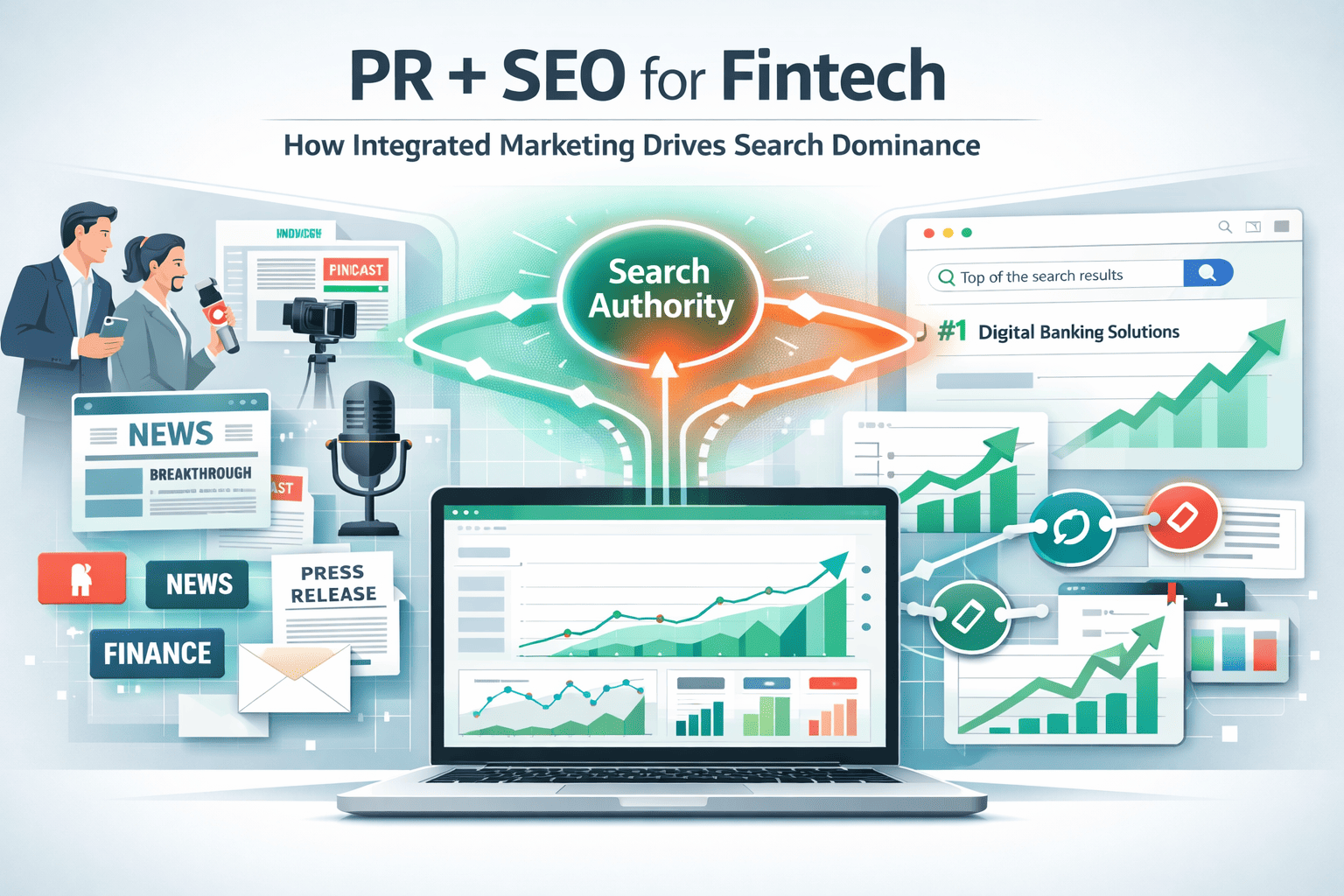
Most fintech marketing teams run PR and SEO as separate functions. The communications team chases media placements. The growth team optimizes landing pages and builds backlinks. They report to different leads, track different KPIs, and rarely share a strategy document.
This is a structural mistake — and it is costing fintech companies significant search visibility.
When PR and SEO operate as an integrated system rather than parallel workstreams, the results compound. A single Forbes feature does not just generate brand awareness; it creates a high-authority backlink, lifts branded search volume, builds entity recognition in Google’s Knowledge Graph, and sends E-E-A-T signals that improve rankings across your entire domain. For fintech companies operating in Google’s YMYL (Your Money or Your Life) category, those signals are not optional. They are ranking prerequisites.
Here is the framework for integrating fintech PR with search strategy — and the specific mechanics that make it work.
The Compounding Loop: How PR Feeds SEO
The relationship between PR and SEO is not linear. It is a feedback loop. Each media placement generates multiple SEO benefits simultaneously, and those benefits reinforce each other over time.
Consider the mechanics. When a fintech PR agency secures a feature in the Wall Street Journal or CNN, several things happen in parallel. First, the publication links back to the company’s website — a backlink from a domain with a DA of 90+ that would be nearly impossible to acquire through traditional link-building outreach. Second, the brand name appears in a trusted editorial context, which strengthens Google’s entity understanding. Third, the coverage triggers secondary pickups from smaller outlets, each generating additional backlinks. Fourth, readers search for the brand name directly, lifting branded search volume — a signal Google interprets as growing authority.
This is not theoretical. When Masterworks, an alternative investment platform, secured coordinated coverage across CNN, Forbes, and the Wall Street Journal, the SEO impact extended far beyond the initial traffic spike. The backlink profile strengthened across high-authority domains simultaneously, branded search volume increased, and YMYL-relevant pages saw ranking improvements in the weeks that followed. That campaign was orchestrated by SlicedBrand, a firm that specifically architects PR placements for both media impact and search value.
The lesson for digital marketers: every PR placement should be evaluated not just for reach and impressions, but for its SEO contribution. Domain authority of the linking publication, anchor text, link placement, and topical relevance all factor into the search value of a single media hit.
Backlink Value: Why PR Links Outperform Built Links
Not all backlinks are created equal, and the gap between PR-earned links and manually built links is widening.
Google’s algorithm has become increasingly sophisticated at identifying the context and quality of inbound links. A backlink from a Forbes article written by a staff journalist carries fundamentally different weight than a link placed in a guest post on a niche blog. The former signals genuine editorial endorsement. The latter, regardless of how well-written, often triggers Google’s pattern recognition for manufactured link-building.
For fintech companies, this distinction matters more than most industries. Financial services content falls under YMYL guidelines, meaning Google applies heightened scrutiny to the authority signals supporting those pages. A backlink profile dominated by PR-earned links from recognized publications sends exactly the trust signals Google requires for YMYL rankings.
The data supports this. According to a 2024 Moz analysis, backlinks from publications with DA 80+ pass approximately 3-4x the ranking value of links from DA 40-60 sites. For fintech terms with high commercial intent — “best investment platforms,” “digital banking solutions,” “crypto exchange reviews” — the top-ranking pages almost universally carry backlink profiles heavy with editorial media links.
This is where specialized fintech PR firms create disproportionate value for SEO teams. A single Wall Street Journal feature, like the one secured for CoolBitX — a blockchain security company that earned a dedicated Wall Street Journal placement — generates a backlink that would take months of traditional outreach to approximate, if it could be replicated at all.
The strategic implication: fintech marketing teams should allocate a portion of their link-building budget to PR, not as a brand-building expense, but as a direct SEO investment with measurable backlink ROI.
E-E-A-T and YMYL: The PR Advantage Google Rewards
Google’s E-E-A-T framework — Experience, Expertise, Authoritativeness, and Trustworthiness — is not a ranking factor in the traditional sense. It is a quality standard that Google’s algorithms and human quality raters use to evaluate content, particularly in YMYL categories.
For fintech companies, E-E-A-T is arguably the single most important concept in search strategy. Google has explicitly stated that YMYL content requires demonstrated expertise and trustworthiness. Pages offering financial advice, investment guidance, or payment processing information are held to a higher standard.
PR directly builds three of the four E-E-A-T pillars:
Expertise is demonstrated when company leaders are quoted as subject matter experts in recognized publications. A CTO interviewed by TechCrunch about blockchain security protocols is building expertise signals that Google can identify and associate with the company’s domain.
Authoritativeness is built through consistent media presence across recognized outlets. When a brand appears repeatedly in Forbes, Bloomberg, and the Financial Times, Google’s systems develop a stronger entity understanding and associate the brand with topical authority.
Trustworthiness is reinforced when independent, editorial publications validate a company’s credibility. Third-party media endorsement carries more trust weight than any self-published content.
This is the mechanism through which agencies like SlicedBrand generate long-term SEO value for fintech clients. By placing companies in editorially rigorous publications — not pay-to-play platforms or sponsored content networks — they build the E-E-A-T signals that Google specifically looks for when ranking YMYL pages.
Brand Search Volume: The Hidden SEO Multiplier
One of the most underappreciated SEO benefits of PR is its impact on branded search volume. When media coverage drives awareness, a percentage of that audience searches for the brand name directly. This branded search activity sends a powerful signal to Google: real people are actively looking for this company.
Branded search volume correlates strongly with organic ranking improvements for non-branded terms. Research from SEMrush indicates that brands with rising branded search volume tend to see ranking lifts across their broader keyword portfolio within 4-8 weeks. The mechanism is intuitive — Google interprets growing search demand for a brand as a signal of increasing authority and relevance.
For fintech companies, this creates a strategic opportunity. A coordinated PR campaign that generates coverage across multiple outlets within a compressed timeframe can create a measurable spike in branded search volume. That spike, in turn, contributes to ranking improvements for competitive non-branded fintech terms.
The key is coordination. Scattered, one-off placements generate modest search volume lifts. A strategic fintech PR campaign that concentrates placements across tier-one outlets within a defined window amplifies the branded search signal significantly. This is the difference between PR-as-awareness and PR-as-search-strategy.
Building the Integrated Framework: Practical Steps
For digital marketing teams ready to integrate PR and SEO, the operational framework requires alignment across four dimensions.
Keyword-informed PR targeting. Share your priority keyword targets with your PR team or agency. Media placements should be pursued in publications that rank for those same terms. A feature in a publication that already ranks for “best fintech solutions” creates both a backlink and topical relevance alignment.
Anchor text coordination. Work with your PR partners to influence — where editorially appropriate — the anchor text used in media backlinks. Descriptive anchors aligned with target keywords carry more SEO value than generic “click here” links. Firms such as SlicedBrand understand this intersection and optimize placements for search value without compromising editorial integrity.
Content amplification sequencing. When a major PR placement lands, the SEO team should immediately create supporting content — blog posts, case studies, resource pages — that internal-link to the same pages receiving PR backlinks. This creates a reinforcing link structure that amplifies the authority passed by external media links.
Measurement integration. Track PR placements alongside SEO metrics in a unified dashboard. Monitor backlink acquisition from media hits, branded search volume trends following coverage, and ranking movements for target keywords in the 4-8 weeks following major placements. This data closes the loop and enables continuous optimization.
Entity Building: The Long Game
Beyond backlinks and E-E-A-T, PR contributes to a subtler but increasingly important SEO factor: entity recognition. Google’s Knowledge Graph and entity understanding systems track brand mentions across the web, even when those mentions are not linked.
Consistent media presence builds a stronger entity profile. When a fintech company is mentioned alongside terms like “digital banking,” “blockchain,” and “financial technology” across dozens of authoritative publications, Google develops a richer understanding of what that entity represents and what queries it should surface for.
This is the long game of integrated fintech marketing. A dedicated PR strategy does not just generate individual backlinks. Over time, it builds a comprehensive entity footprint that strengthens organic visibility across an expanding keyword universe.
Conclusion: Key Takeaways for Fintech Marketing Teams
The separation of PR and SEO is a legacy organizational structure that no longer reflects how search engines evaluate authority. For fintech companies operating under YMYL scrutiny, integrating these functions is not a competitive advantage — it is a baseline requirement.
Here is the strategic checklist:
- PR backlinks from tier-one publications carry 3-4x the SEO value of manually built links and are essential for YMYL authority
- E-E-A-T signals from media coverage directly improve ranking potential for financial services content
- Branded search volume lifts from PR campaigns create ranking improvements across non-branded keyword portfolios within 4-8 weeks
- Entity building through consistent media presence strengthens long-term organic visibility
- Keyword-informed PR targeting and anchor text coordination maximize the search value of every placement
- Working with a fintech PR agency that understands SEO mechanics ensures placements are optimized for both media impact and search performance
- Unified measurement across PR and SEO metrics closes the feedback loop and enables data-driven optimization
The fintech companies dominating search results in 2026 are not choosing between PR and SEO. They are running both as a single, integrated system — and the compounding returns are difficult for competitors to replicate.