Table of Contents
- Understanding Topic Clusters: The Evolution of SEO Content Strategy
- Why Pillar Content Hubs Outperform Single Pages
- Building Effective Topic Clusters: A Step-by-Step Guide
- Measuring the Success of Your Topic Clusters
- Common Challenges and How to Overcome Them
- Topic Cluster Success Stories: Real-World Examples
- Future Trends in Topic Cluster SEO
In today’s increasingly competitive digital landscape, creating a single high-quality page targeting a specific keyword is no longer enough to establish meaningful search visibility. Search engines have evolved to prioritize content that demonstrates comprehensive expertise on a subject rather than isolated pages that address individual queries.
Enter topic-cluster SEO—a strategic content architecture approach that creates interconnected content ecosystems around core topics relevant to your business. By building pillar hubs with supporting cluster content, organizations can establish unparalleled topical authority, improve user experience, and ultimately outrank competitors who rely on disconnected single-page strategies.
At Hashmeta, our AI-powered SEO services have helped over 1,000 brands across Asia implement effective topic cluster strategies that drive sustainable organic growth. In this comprehensive guide, we’ll explore how topic clusters work, why they’re superior to isolated content approaches, and provide a detailed framework for building pillar content hubs that dominate search results.
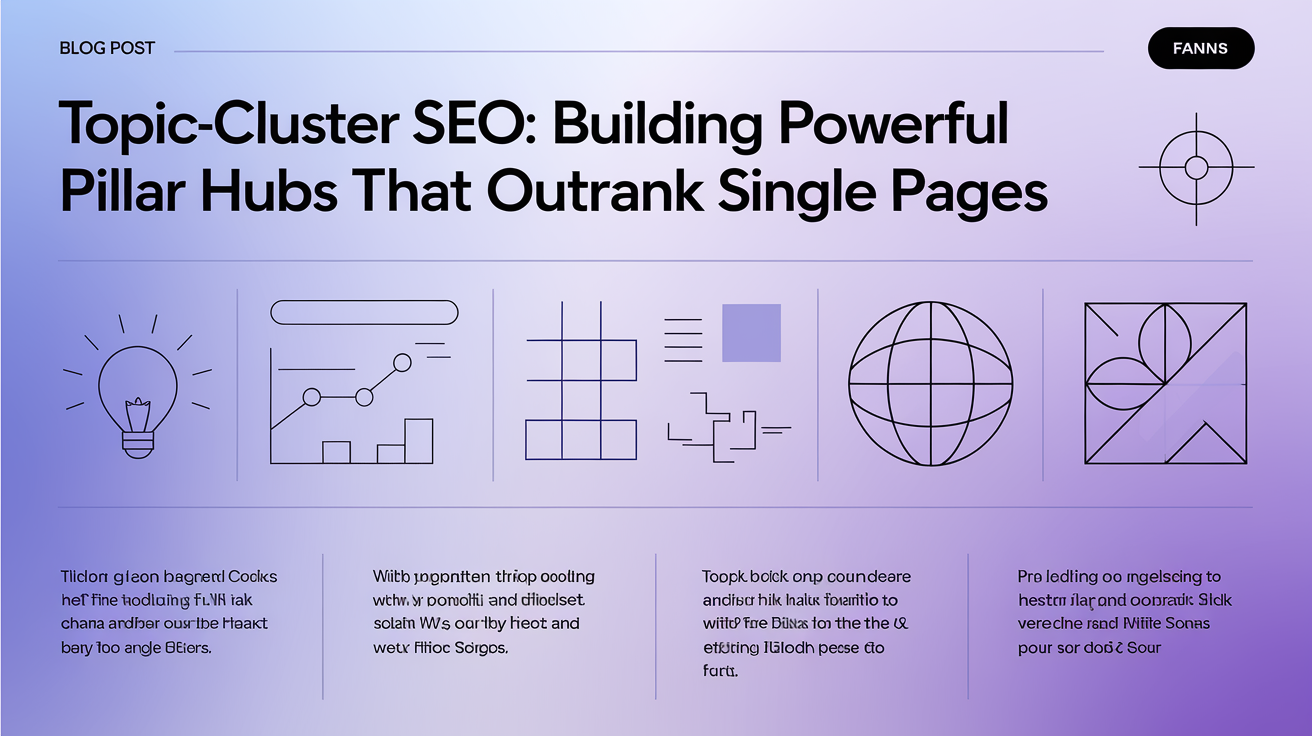
Topic-Cluster SEO Strategy
Building Pillar Hubs that Outrank Single Pages
What Are Topic Clusters?
A strategic content architecture approach that creates interconnected content ecosystems around core topics relevant to your business:
- Pillar Page: Comprehensive resource broadly covering a core topic
- Cluster Content: Supporting pieces exploring specific aspects in detail
- Internal Linking: Strategic connections between content pieces
PAGE
Why Pillar Hubs Outperform Single Pages
Topical Authority
Demonstrates comprehensive expertise on subjects rather than isolated topics
Search Real Estate
Captures multiple positions in SERPs for related queries and diverse search intents
Enhanced UX
Improves user experience with intuitive navigation between related content
6-Step Framework for Building Topic Clusters
Identify Core Topics & Subtopics
Audit Existing Content
Create Your Pillar Content
Develop Cluster Content
Implement Strategic Internal Linking
Optimize for Search & UX
Real-World Results from Topic Clusters
- 215% increase in organic traffic
- Top 3 rankings for 70+ keywords
- 28% higher conversion rate
- 47% growth in qualified leads
- Reduced CPAs vs. paid channels
- Improved thought leadership
- Top position for target keywords
- 300% increase in consultations
- 3.7 pages avg. per session
Start Building Your Topic Clusters Today
Transform your content strategy with high-performing topic clusters that establish topical authority and drive sustainable organic growth.
Powered by Hashmeta Digital Marketing Agency
Understanding Topic Clusters: The Evolution of SEO Content Strategy
Topic clusters represent a strategic shift in content organization that aligns with how modern search engines evaluate content quality and relevance. Instead of creating isolated pages that compete independently for rankings, a topic cluster unifies your content into a coherent ecosystem that signals comprehensive expertise.
The Anatomy of a Topic Cluster
A complete topic cluster consists of two primary components:
Pillar Page: This serves as the centerpiece of your cluster—a comprehensive resource that broadly covers a core topic while linking to more specific subtopics. Pillar pages are typically longer, more authoritative pieces that provide a complete overview of the main subject.
Cluster Content: These are supporting content pieces that explore specific aspects of the main topic in greater detail. Each cluster page addresses a particular subtopic related to the pillar content and links back to the pillar page, creating a network of interconnected content.
The internal linking structure between pillar and cluster content is what transforms individual pages into a powerful content ecosystem. This structure helps search engines understand the relationship between topics and subtopics while providing users with a structured path to explore related information.
The Shift from Keywords to Topics
Topic clusters represent a fundamental evolution in SEO strategy—moving from keyword-centric approaches to topic-based content architectures. This shift mirrors how search engines like Google have evolved their algorithms to better understand semantic relationships between content.
While traditional SEO focused primarily on optimizing for specific keywords, modern search engines use sophisticated natural language processing and AI technologies to evaluate content based on topical relevance, comprehensiveness, and authority. Topic clusters align perfectly with this approach by creating content ecosystems that demonstrate depth and breadth of expertise on specific subjects.
At Hashmeta’s AI marketing division, we leverage advanced semantic analysis to identify topic relationships that might not be immediately obvious, helping clients build more effective content clusters that align with both user needs and search engine capabilities.
Why Pillar Content Hubs Outperform Single Pages
Creating comprehensive topic clusters requires more planning and resources than publishing individual pages. So why invest in this approach? The evidence clearly shows that well-structured topic clusters consistently outperform isolated content strategies for several key reasons:
Establishing Topical Authority
Search engines evaluate your website’s authority on specific topics—not just by the quality of individual pages, but by your comprehensive coverage of a subject area. When you build interconnected topic clusters, you signal to search engines that your site offers deep expertise on particular subjects.
This topical authority becomes a powerful ranking factor. Sites with demonstrated expertise on specific topics are more likely to rank higher for a wide range of related queries than sites with scattered, unrelated content—even if individual pages on the latter sites are well-optimized.
Capturing More Search Real Estate
A well-structured topic cluster can help you capture multiple positions in search results for related queries. Rather than competing against yourself with multiple pages targeting similar keywords, topic clusters allow you to position different content pieces to capture diverse search intents around a core topic.
For example, a financial services company might create a pillar page on “retirement planning” with cluster content focused on specific aspects like “retirement tax strategies,” “retirement accounts comparison,” and “retirement planning by age.” Each piece targets different search intents while reinforcing the site’s overall authority on retirement planning.
Internal Linking Benefits
The interconnected nature of topic clusters creates a powerful web of internal links that distribute page authority throughout your site. Each cluster page linking back to the pillar content provides valuable link equity, while the pillar page distributes authority to the cluster content by linking out to these supporting pages.
This strategic internal linking structure helps search engines discover and index your content more effectively while also distributing ranking power across your content ecosystem. Our SEO agency specialists have observed that implementing proper topic cluster linking structures can improve crawl efficiency by up to 40% for complex websites.
Enhanced User Experience
Beyond search engine benefits, topic clusters create a more intuitive navigation structure for your users. Visitors can easily find related information without returning to search results, increasing engagement metrics like time on site and pages per session.
This improved user experience sends positive signals to search engines about the value of your content. At Hashmeta, our analysis of client websites before and after implementing topic clusters shows an average 32% increase in pages per session and a 27% reduction in bounce rates across pillar and cluster content.
Building Effective Topic Clusters: A Step-by-Step Guide
Creating topic clusters that outrank competitors requires a strategic approach to planning, content development, and optimization. Here’s our proven methodology for building high-performing topic clusters:
Step 1: Identify Core Topics and Subtopics
Begin by identifying the primary topics that align with your business offerings and audience interests. These will serve as the foundations for your pillar pages. The best pillar topics share several characteristics:
They’re broad enough to support multiple subtopics but specific enough to maintain focus and relevance. They align with your business objectives and expertise. They have sufficient search volume to justify the investment in comprehensive content development.
Once you’ve identified potential pillar topics, conduct keyword research to identify related subtopics that will form your cluster content. Look for questions, related concepts, and specific aspects of the main topic that users are searching for.
Our AI SEO platform can identify semantic relationships between topics and subtopics, helping you map out comprehensive topic clusters that address the full spectrum of user search intent.
Step 2: Audit Existing Content
Before creating new content, inventory your existing assets to identify what can be repurposed or expanded for your topic clusters. This audit should include:
Identifying existing content that aligns with your pillar topics and subtopics. Evaluating content quality and comprehensiveness. Finding content gaps that need to be filled. Mapping out current internal linking structures.
This audit provides a foundation for your content development plan and helps you prioritize resources effectively. Our team of SEO consultants typically finds that clients can repurpose 30-40% of existing content when implementing new topic cluster strategies.
Step 3: Create Your Pillar Content
Your pillar page serves as the cornerstone of your topic cluster, so it needs to be comprehensive, authoritative, and valuable to users. Effective pillar content typically:
Provides a complete overview of the topic without becoming too detailed on any one aspect. Uses a clear, logical structure with well-organized headings. Incorporates strategic internal links to cluster content. Includes rich media such as images, videos, or interactive elements. Demonstrates expertise and builds trust with users.
Pillar pages are generally longer than standard content, often 2,000-5,000 words, though the appropriate length depends on the topic complexity and competitive landscape. The goal isn’t length for its own sake but comprehensive coverage that satisfies user intent.
At Hashmeta, our content marketing specialists develop pillar content that balances comprehensive coverage with engaging presentation to maximize both user engagement and search visibility.
Step 4: Develop Cluster Content
With your pillar content in place, develop supporting cluster content that explores specific aspects of your main topic in greater detail. Effective cluster content:
Focuses on a specific subtopic related to the pillar content. Targets more specific long-tail keywords with clear search intent. Provides in-depth coverage that goes beyond what’s included in the pillar page. Links back to the pillar page and, where appropriate, to other related cluster content.
Each piece of cluster content should be valuable as a standalone resource while also contributing to the overall authority of your topic cluster. Our AI marketing agency tools help identify the most valuable subtopics to prioritize based on search volume, competition, and relevance to your business objectives.
Step 5: Implement Strategic Internal Linking
Internal linking is what transforms individual content pieces into a cohesive topic cluster. Your internal linking strategy should follow these principles:
Every cluster page should link back to the pillar page using relevant anchor text. The pillar page should link to each cluster page, ideally from the most relevant section. Where appropriate, cluster pages can link to other closely related cluster pages. Anchor text should be descriptive and include relevant keywords without being overly optimized.
This interconnected structure helps both users and search engines understand the relationships between different aspects of your topic. Our SEO teams have found that implementing proper internal linking structures can improve organic visibility for cluster content by an average of 35% within the first three months.
Step 6: Optimize for Search and User Experience
Beyond creating valuable content and implementing internal linking, optimize your topic clusters for both search engines and users:
Ensure all pages use descriptive, keyword-rich titles and meta descriptions. Implement schema markup to help search engines understand your content. Optimize page load speed and mobile responsiveness. Create clear navigation paths that help users explore related content. Use engaging visuals and formatting to improve readability.
These optimization tactics enhance the performance of your entire topic cluster. The combination of comprehensive content, strategic internal linking, and technical optimization creates a powerful foundation for improved search visibility.
Measuring the Success of Your Topic Clusters
Effective measurement is essential to understand the impact of your topic cluster strategy and identify opportunities for improvement. Here are the key metrics to track:
Organic Performance Metrics
Track these search performance indicators for both pillar and cluster content:
Organic rankings for target keywords. Organic traffic to individual pages and the cluster as a whole. Click-through rates from search results. Search visibility for related keywords beyond your primary targets.
Look at these metrics both individually and collectively to understand how your topic cluster is performing as an ecosystem. Often, the combined traffic to a complete topic cluster will significantly exceed what individual, unconnected pages could achieve.
User Engagement Metrics
User engagement signals provide insights into how effectively your topic cluster meets visitor needs:
Time on page and bounce rates. Pages per session for visitors landing on cluster content. Internal navigation patterns between pillar and cluster content. Conversion rates for visitors exploring multiple cluster pages.
These engagement metrics help you understand how users interact with your topic clusters and identify opportunities to improve the user experience. Our consulting team has found that visitors who engage with multiple pages within a topic cluster are 3.2 times more likely to convert than visitors who view only a single page.
ROI Assessment
To determine the business impact of your topic clusters, track:
Conversion rates and goal completions from cluster traffic. Lead quality from organic traffic to topic clusters. Revenue attributed to organic traffic from your clusters. Resource investment compared to performance gains.
This ROI assessment helps you quantify the business value of your topic cluster strategy and make data-driven decisions about future content investments. Our marketing technology platforms provide comprehensive attribution modeling to accurately measure the impact of topic clusters on business outcomes.
Common Challenges and How to Overcome Them
While topic clusters are highly effective, implementing them successfully comes with challenges. Here are common obstacles and strategies to address them:
Resource Constraints
Creating comprehensive topic clusters requires significant content development resources. To manage this challenge:
Prioritize clusters based on business impact and competitive opportunity. Implement a phased approach, starting with pillar content and gradually adding cluster pages. Repurpose and expand existing content where possible. Consider partnering with specialized agencies like Hashmeta that offer scaled content production capabilities.
Our ecosystem of content specialists can help accelerate topic cluster development while maintaining consistent quality and strategic alignment.
Content Cannibalization
Without careful planning, different pages within your site can compete for the same keywords, causing content cannibalization. To prevent this:
Clearly define the scope and focus of each piece within your cluster. Use keyword mapping to ensure different pages target distinct search intents. Implement proper internal linking to signal the primary page for each target keyword. Regularly audit your content to identify and resolve cannibalization issues.
Our SEO services include comprehensive cannibalization analysis to ensure your topic clusters work together effectively rather than competing with each other.
Maintaining Cluster Relevance
As search trends and industry knowledge evolve, topic clusters need to be updated to maintain relevance. To address this:
Implement a regular content audit schedule to identify outdated information. Monitor search trends related to your clusters to identify emerging subtopics. Update pillar content to incorporate new developments in your field. Add new cluster content as relevant subtopics emerge.
This ongoing maintenance ensures your topic clusters remain authoritative and continue to meet user needs as your industry evolves.
Topic Cluster Success Stories: Real-World Examples
To illustrate the impact of effective topic clusters, here are examples from different industries:
E-commerce: Fashion Retailer
A leading fashion retailer worked with Hashmeta to develop comprehensive topic clusters around sustainable fashion. Their pillar page on “Sustainable Fashion Guide” linked to cluster content on specific topics like sustainable fabrics, ethical manufacturing practices, and caring for sustainable garments.
Within six months of implementation, the topic cluster generated:
A 215% increase in organic traffic to sustainable fashion content. Top 3 rankings for over 70 sustainable fashion-related keywords. A 28% higher conversion rate compared to their traditional product pages. Significant improvement in average order value for visitors engaging with multiple cluster pages.
The success of this topic cluster led the retailer to expand their content strategy to include additional clusters around seasonal fashion and style guides.
B2B: Enterprise Software Provider
An enterprise software company specializing in supply chain management implemented topic clusters around key business challenges their solutions addressed. Their pillar page on “Supply Chain Optimization” connected to cluster content on inventory management, demand forecasting, logistics efficiency, and supply chain analytics.
Results included:
Increased organic visibility for high-value, purchase-intent keywords. 47% growth in qualified leads from organic search. Reduced cost-per-acquisition compared to paid channels. Improved thought leadership positioning in their industry.
By demonstrating comprehensive expertise on supply chain challenges, they were able to engage prospects earlier in the buying journey and establish credibility that supported their sales efforts.
Service Business: Financial Advisory Firm
A financial advisory firm created topic clusters around retirement planning, investment strategies, and tax optimization. Their comprehensive approach to financial content elevated them from local visibility to national recognition as a financial planning resource.
Their retirement planning cluster, in particular, delivered impressive results:
Top position for “retirement planning strategy” and related terms. Over 300% increase in consultation requests from organic traffic. Extended geographical reach beyond their local service area. Significantly improved engagement metrics, with visitors exploring an average of 3.7 pages per session.
These case studies demonstrate how topic clusters can deliver significant SEO benefits while also supporting broader business objectives across different industries and business models. Our marketing academy regularly shares detailed case studies and implementation strategies for topic cluster optimization.
Future Trends in Topic Cluster SEO
The digital landscape continues to evolve, and topic cluster strategies must adapt accordingly. Here are emerging trends that will shape the future of topic cluster SEO:
AI-Enhanced Content Development
AI technologies are increasingly being used to identify content opportunities, analyze semantic relationships between topics, and even assist in content creation. Hashmeta’s AI marketing platforms leverage these technologies to help clients develop more comprehensive and effective topic clusters.
As AI capabilities continue to advance, we anticipate more sophisticated approaches to topic identification, content gap analysis, and even automated content recommendations to strengthen existing clusters.
Integration with Video and Visual Content
The future of topic clusters will extend beyond text-based content to incorporate video, interactive experiences, and visual content. This multi-format approach creates more engaging user experiences while capturing traffic from both traditional search and visual/video search platforms.
Forward-thinking organizations are already developing integrated topic strategies that leverage text, video, images, and interactive content to create truly comprehensive resources. Our influencer marketing agency services can help integrate creator content into your topic clusters for added authority and engagement.
Cross-Platform Topic Authority
As users engage with content across multiple platforms, establishing topical authority will increasingly require a cross-platform approach. This includes coordinating content across your website, social media channels, video platforms, and even platforms like Xiaohongshu for brands targeting Asian markets.
Our AI Influencer Discovery tools can identify subject matter experts to amplify your topic authority through collaborative content development, further strengthening your position as an authoritative resource.
By anticipating these trends and adapting your topic cluster strategy accordingly, you can maintain a competitive advantage in an increasingly sophisticated search landscape. The organizations that build comprehensive, adaptable topic ecosystems will continue to outperform those relying on disconnected content approaches.
Conclusion: Building Topic Authority Through Strategic Content Clusters
Topic clusters represent a fundamental evolution in content strategy—moving beyond isolated pages to create interconnected content ecosystems that establish meaningful authority around subjects important to your business. By developing comprehensive pillar pages and supporting cluster content, you can build a content foundation that consistently outperforms single-page strategies in today’s search landscape.
The benefits extend far beyond SEO rankings. Well-executed topic clusters improve user experience, establish your brand as an authoritative resource, support the buyer journey more effectively, and create sustainable competitive advantages in organic search visibility.
While implementing effective topic clusters requires significant planning and resources, the long-term return on this investment typically far exceeds what can be achieved through disconnected content approaches. By following the framework outlined in this guide—from initial topic identification through continuous optimization—you can develop topic clusters that drive sustainable organic growth for your business.
At Hashmeta, our team of specialists combines AI-powered tools with deep SEO expertise to help clients implement high-performing topic cluster strategies. From opportunity identification through content development and performance measurement, we provide the guidance and support needed to build content ecosystems that establish meaningful topical authority.
Ready to transform your content strategy with high-performing topic clusters?
Our team of SEO specialists and content strategists can help you identify opportunities, develop comprehensive topic clusters, and measure the impact on your organic visibility and business results.