Picture this: your website holds a strong first-page ranking, your content calendar is running on schedule, and your team is executing the same SEO playbook that delivered results two years ago. Yet your organic traffic is quietly bleeding out. You are not being outranked. You are being bypassed.This is the reality confronting digital marketers across Southeast Asia and globally in 2026. Organic click-through rates have collapsed — not because search volume dropped, but because AI-powered search engines are now answering questions before users ever see your link. The game has changed structurally, and the strategies that powered the last decade of search marketing are no longer enough on their own.The answer is Generative Engine Optimization (GEO) — the practice of optimising your brand to appear inside the AI-generated answers that are now consuming the clicks that used to be yours. In this article, we unpack what is driving the CTR decline, what GEO is and how it works, and the practical strategies your brand needs to reclaim visibility in an AI-first search landscape.
The Organic CTR Freefall Nobody Warned You About
The numbers are stark, and they are getting harder to ignore. Organic click-through rates for informational queries featuring Google AI Overviews fell 61% since mid-2024, while paid CTRs on those same queries plunged 68%, according to a study by marketing agency Seer Interactive. That is not a seasonal dip or an algorithm tremor you can wait out. It is a structural realignment of how search actually works.
What makes the situation even more alarming is how broad the damage is. Even on queries without AI Overviews, organic CTRs fell 41%, suggesting users are simply clicking less, everywhere. Meanwhile, organic traffic in 2025 is experiencing what industry analysts call ‘The Great Decoupling’ — a phenomenon where search engine usage continues to rise while clicks to websites decline dramatically, with 60% of Google searches now ending without any click to a website.
The impact is not confined to small publishers. The median publisher experienced a 10% year-over-year traffic decline in the first half of 2025, with non-news content sites down 14%.Advanced Web Ranking tracked AI Overview prevalence growing from 18.55% of search results in Q3 2024 to 49.92% by Q4 2025 — nearly half of all search results. If you have been waiting for things to stabilise, the data is delivering an unambiguous message: this is the new baseline.
What Is Actually Killing Your Organic Click-Through Rates
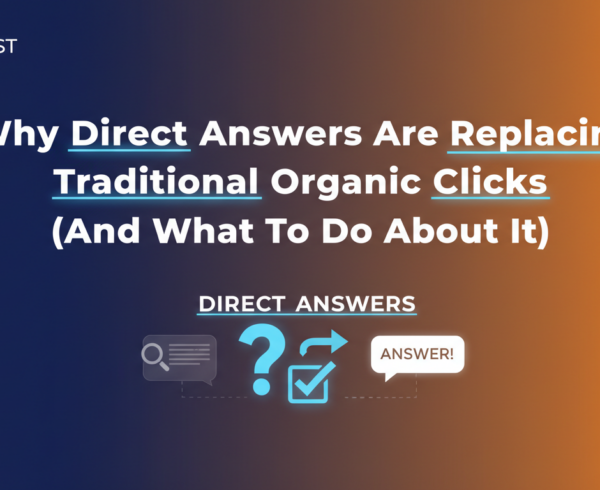
The primary culprit is not a Google penalty or a competitor out-executing your content team. It is a fundamental shift in where and how users consume answers. What changed with AI Overviews is that queries which previously would have generated clicks — informational and research-intent queries — now resolve on the SERP. The user gets the answer they came for without ever visiting your website.
Google AI Mode has pushed this dynamic even further. According to Semrush data, 93% of searches conducted in AI Mode end without a single click to an external website.Users spend an average of 49 seconds in AI Mode — double the 21 seconds in standard AI Overviews — signalling deeper engagement with the AI surface itself, not with external websites. The longer users engage with AI-generated answers, the less incentive they have to click through anywhere.
The problem compounds when you consider how rapidly AI-driven search is spreading. Broader forces are at work beyond just AI Overviews. Users are likely seeking answers in other places before Google, including ChatGPT, Perplexity, social platforms, or going directly to trusted brands. The traditional search funnel — query, SERP, click, website — is fragmenting across multiple AI platforms simultaneously. Brands that only optimise for one of those touchpoints will find themselves invisible at the others.
For B2B marketers, the implications are particularly sharp. 73% of B2B websites experienced significant traffic loss between 2024 and 2025, with average year-on-year declines reaching 34%. Critically, 85% of B2B buyers purchase from their ‘day one’ vendor list — companies they had in mind before they searched — and zero-click search is severing brands’ ability to insert themselves into that list formation process. When the discovery moment resolves on the AI answer surface, brands not featured there simply do not get considered.
What Is GEO (Generative Engine Optimization)?
Generative Engine Optimization (GEO) is the practice of optimising your content and brand presence so that AI-powered search systems — including ChatGPT, Google AI Overviews, Perplexity, Google Gemini, and Microsoft Copilot — select, cite, and reference your brand when generating answers for users. Where traditional SEO focuses on ranking your page in the list of results, GEO focuses on getting your brand inside the answer itself.
The distinction matters because of how these systems work. GEO optimises for how AI-powered engines parse, embed, and synthesise information. These engines tokenise your HTML, move it into vector space, and stitch it into conversational answers. They are not scanning for keyword density or counting backlinks in the traditional sense. They are evaluating how clearly your content communicates, how credibly it is cited across the web, and how confidently they can attribute an answer to your brand.
Generative Engine Optimization is the natural evolution of SEO in the world of ChatGPT. GEO focuses on optimising brand content for AI engines like ChatGPT, Google Gemini, Google AI Mode, and Perplexity. It is not a replacement for the search marketing fundamentals you have already invested in — it is the layer that extends those fundamentals into the AI-generated surfaces where your buyers are increasingly spending their attention. Hashmeta’s dedicated GEO services are built precisely around this next-generation visibility challenge.
GEO vs. SEO vs. AEO: Understanding the New Search Stack
Modern search visibility is no longer a single discipline. It is a stack of complementary strategies, each addressing a different layer of how people find information today. Understanding how they relate to one another is essential before deciding where to focus your investment.
SEO, AEO, and GEO serve different but complementary purposes. SEO helps content rank in traditional search engines, AEO helps content appear as direct answers in search and voice assistants, and GEO helps content get cited in AI-generated responses. Think of it as building a presence across the full discovery journey: being findable in blue-link results, being extractable as a direct answer, and being trustworthy enough for an AI to quote.
| SEO | AEO | GEO | |
|---|---|---|---|
| Goal | Rank in traditional search results | Appear as a direct answer or snippet | Be cited inside AI-generated responses |
| Key tactics | Technical health, keywords, backlinks | Schema markup, FAQs, structured answers | Credibility signals, citations, clarity, fresh content |
| Primary metric | Keyword rankings, organic traffic | Featured snippet ownership, voice search visibility | AI citations, AI share of voice, brand mentions in LLMs |
SEO remains the foundation of digital visibility. Strong technical SEO, high-quality content, and authority signals are essential for both traditional search rankings and AI discovery.AEO (Answer Engine Optimisation) builds on that foundation by structuring content for extractability. GEO then extends your reach into the AI-generated answers that are now intercepting the majority of high-intent queries. The brands that win now are not choosing between SEO, AEO, and GEO. Instead, they are building integrated digital strategies that rank, get extracted, and get referenced — all at once.
Why GEO Directly Addresses the CTR Problem
Here is the part that changes the strategic calculus entirely. While AI Overviews are suppressing clicks for brands that are not cited, they are generating a significant traffic and conversion advantage for brands that are cited. Brands cited in AI Overviews earn 35% more organic clicks and 91% more paid clicks.AI citations are becoming the new ‘position zero’ — and most companies have no strategy for earning them.
The conversion quality of AI-referred traffic is also substantially higher than traditional organic search. LLM visitors convert at 15.9% from ChatGPT, 10.5% from Perplexity, and 5% from Claude, compared to a 1.76% organic search conversion rate. Ahrefs found AI search visitors generated 12.1% of signups despite accounting for only 0.5% of total visitors — a 24:1 conversion ratio relative to organic search. The users arriving through AI citations are not casual browsers; they are buyers who have already consulted an AI, received a recommendation, and are now acting on it.
This reframes the entire opportunity. GEO is not a defensive play against declining CTRs. It is an offensive strategy to capture a smaller but far more commercially valuable stream of traffic. Success metrics are shifting from clicks and traffic to visibility and share of voice. The brands building GEO equity now are positioning themselves as the default recommendations across every AI platform their prospective customers consult — from ChatGPT to Perplexity to Google AI Overviews. For brands seeking a comprehensive AI marketing strategy, GEO is no longer optional.
Core GEO Strategies That Drive AI Citations
GEO is not a single tactic — it is a set of signals that AI systems weigh when deciding whether to trust and cite your content. The most effective strategies combine content quality, structural clarity, and off-site credibility. Here is what the research shows actually moves the needle.
1. Build Content with Quotes, Statistics, and Cited Sources
Research from Princeton and the Allen Institute for AI showed that targeted optimisation can increase a source’s visibility in generative AI answers by up to 40%. The strongest methods were adding quotes (+27.8%), adding statistics (+25.9%), and citing sources (+24.9%). Content that reads like well-researched thought leadership — backed by data, attributed to experts, and anchored in evidence — is exactly what AI systems want to quote. Every piece of content marketing output should now be built with this standard in mind.
2. Earn Brand Mentions Across High-Authority Platforms
AI search works on intent, not just keywords. It reads content and grounds answers with sources. It leans on third-party citations, community threads, and trusted publications — and it trusts what others say about you more than what you say about yourself. This means your GEO strategy must extend beyond your own website. Press coverage, industry publications, influencer mentions, and participation in authoritative community platforms all contribute to the trust signals that AI systems use to determine citation worthiness. A strong influencer marketing programme is one of the most direct ways to build this kind of earned visibility at scale.
3. Ensure Your Content Is Technically Accessible to AI Crawlers
AI crawlers use the same site architecture, sitemaps, and technical signals that traditional search bots have always used. Without a technically sound website, GEO and AEO efforts cannot perform. Beyond standard technical SEO, server-side rendering is especially important, as AI crawlers have documented difficulty executing JavaScript — meaning client-side rendered content may simply be invisible to them. Your website design and architecture decisions directly affect your GEO performance, not just your user experience. Tools like AppearSearch can help identify how your brand surfaces across AI-driven discovery environments.
4. Publish Fresh, Relevant Content Consistently
AI systems favour recency. Reviewing and updating key content every 90 days helps align with evolving AI models and shifting user intent. Brands that treat content as a one-time investment rather than a living asset will find their AI citations eroding as newer, more current sources crowd them out. Regular content refreshes, particularly for topic clusters closely tied to your core business, are a direct lever for maintaining and growing your AI share of voice. This is especially important for rapidly evolving sectors across Southeast Asia’s digital economy, where platform-specific marketing and regional trends move quickly.
5. Strengthen Brand Clarity and Consistency Across All Digital Touchpoints
Visibility in AI now depends on clarity, credibility, and consistency across digital ecosystems — not just keyword rankings.Fragmentation kills discoverability. Disjointed websites, messaging, and product structures create confusion for AI systems and reduce your chances of appearing in answers. AI systems are, at their core, pattern-recognition engines. The more coherently and consistently your brand story is told across your website, social channels, third-party mentions, and structured data, the more confidently an AI can represent and recommend you. A strong AI SEO strategy addresses this at the technical, content, and off-site level simultaneously.
How to Measure Your GEO Performance
One of the biggest challenges brands face with GEO is the measurement gap. Traditional analytics tools — Google Analytics, Search Console — were built for the world of clicks. They cannot tell you whether ChatGPT is recommending your product or whether your brand appears in the AI-generated travel guides your prospective customers are reading on Perplexity. You need a new measurement layer.
The key GEO metrics to track include:
- AI citation frequency: How often your brand or content is referenced across ChatGPT, Perplexity, Google AI Overviews, and Gemini for your target queries.
- AI share of voice: Your brand’s citation rate relative to key competitors across AI platforms for category-level questions.
- Brand sentiment in AI responses: Whether AI systems are characterising your brand positively, neutrally, or negatively.
- AI-referred traffic and conversion rate: Tracking sessions that arrive from AI platform referrals — and their conversion performance, which as noted tends to be dramatically higher than standard organic.
- Prompt ranking: Monitoring where your brand appears within AI-generated responses for the queries most critical to your business.
Traditional metrics like clicks and traffic are no longer enough — success now requires tracking share of voice, visibility in AI responses, and citation frequency. Platforms like LocalLead AI and StarScout AI are examples of how AI-native discovery and visibility intelligence tools are evolving to fill this measurement gap. The brands that invest in GEO measurement infrastructure now will have a compounding advantage as AI search continues to grow.
Semrush, the source of the AI Mode data cited earlier, is a search visibility platform rather than a conventional SEO tool. It covers rankings, backlinks, keywords, content and competitive research, and layers AI visibility on top of all of it.
Three parts speak directly to the CTR problem this article describes. The AI Visibility Score (0–100) benchmarks how present your brand is inside generative answers. Prompt Tracking monitors, daily, which questions you surface for and which ones hand the answer to a competitor. The Brand Performance dashboards track mentions, sentiment and share of voice against named rivals.
Coverage spans ChatGPT, Google AI Overviews, Google AI Mode, Gemini and Perplexity — the five surfaces now absorbing the clicks your organic listings used to earn. Semrush ran the same playbook on itself and reports growing its own AI share of voice from 13% to 32% in a single month.
See where AI search is quoting your competitors instead of you
Track your AI Visibility Score across ChatGPT, Google AI Overviews, AI Mode, Gemini and Perplexity.
Start your 14-day free trial →
GEO Does Not Replace SEO — It Completes It
There is an important reassurance for any marketing team that has built years of SEO equity: GEO is not a reset. GEO, SEO, and AEO are complementary disciplines that work together to maximise content visibility across different discovery channels. Understanding their relationships helps you allocate resources effectively — and strong technical SEO, quality backlinks, and good user experience establish your site as authoritative, which underpins all three disciplines.
Your existing SEO investment is not wasted — it is foundational. The domain authority, quality backlinks, and technically sound architecture you have built are exactly the trust signals that AI systems draw on when deciding which sources to cite. What GEO requires is an additional layer of optimisation: content structured for AI extractability, off-site mentions built for credibility rather than just link equity, and brand signals managed for consistency across the entire digital ecosystem.
For brands in competitive Asian markets — whether competing for visibility in Singapore, Malaysia, Indonesia, or beyond — the window for early GEO adoption is still open. We are still in the early stages of AI search and how it will change the overall search landscape. Adopting an AI search strategy now sets you up for better adaptability and continued visibility as trends and platforms evolve. The brands building GEO authority today are writing the citation history that AI systems will draw on for years to come. Whether you are working with a specialist SEO consultant to audit your current position or seeking full-service support from an AI agency, the strategic imperative is the same: show up in the answer, not just the results.
The New Visibility Imperative
Organic CTRs are not recovering. The data is consistent across dozens of independent studies — AI-generated answers are intercept the clicks that used to flow to your website, and the trend is accelerating, not plateauing. The brands that continue optimising exclusively for traditional search rankings are building on a shrinking foundation.
GEO is not a trend to watch from a distance. It is the direct, evidence-backed response to the structural shift that is already costing brands traffic, pipeline, and revenue. And crucially, the brands cited inside AI answers are not just surviving the CTR decline — they are winning a higher-quality, higher-converting audience than traditional organic search ever delivered.
The question is not whether to invest in GEO. It is whether to start now, while the competitive landscape is still taking shape, or later, when AI citation authority has already been claimed by your competitors. As an integrated AI marketing agency operating across Singapore, Malaysia, Indonesia, and China, Hashmeta is uniquely positioned to help your brand build that authority across the AI search platforms your buyers are using today.
Ready to Build Your GEO Strategy?
Declining organic CTRs are a signal, not a sentence. With the right GEO strategy in place, your brand can earn citations across ChatGPT, Google AI Overviews, Perplexity, and more — putting you inside the answers your customers are already reading. Let Hashmeta’s team of AI search specialists build a visibility strategy that works for the search landscape of today, not 2020.