


Generative Engine Optimization (GEO) is the practice of optimizing digital content so that AI search engines—such as ChatGPT, Perplexity, Google AI Overviews, and Meta AI—can discover, understand, and cite your brand in their generated responses. Unlike traditional SEO which focuses on ranking web pages in search results, GEO ensures your business becomes the referenced answer when users ask conversational, intent-driven questions.
For CMOs and marketing directors at Philippine enterprises, GEO is no longer experimental—it is mission-critical infrastructure for visibility in the zero-click search era (where users get answers directly from AI without visiting websites).
What is Generative Engine Optimization and Why Does It Matter in 2026?
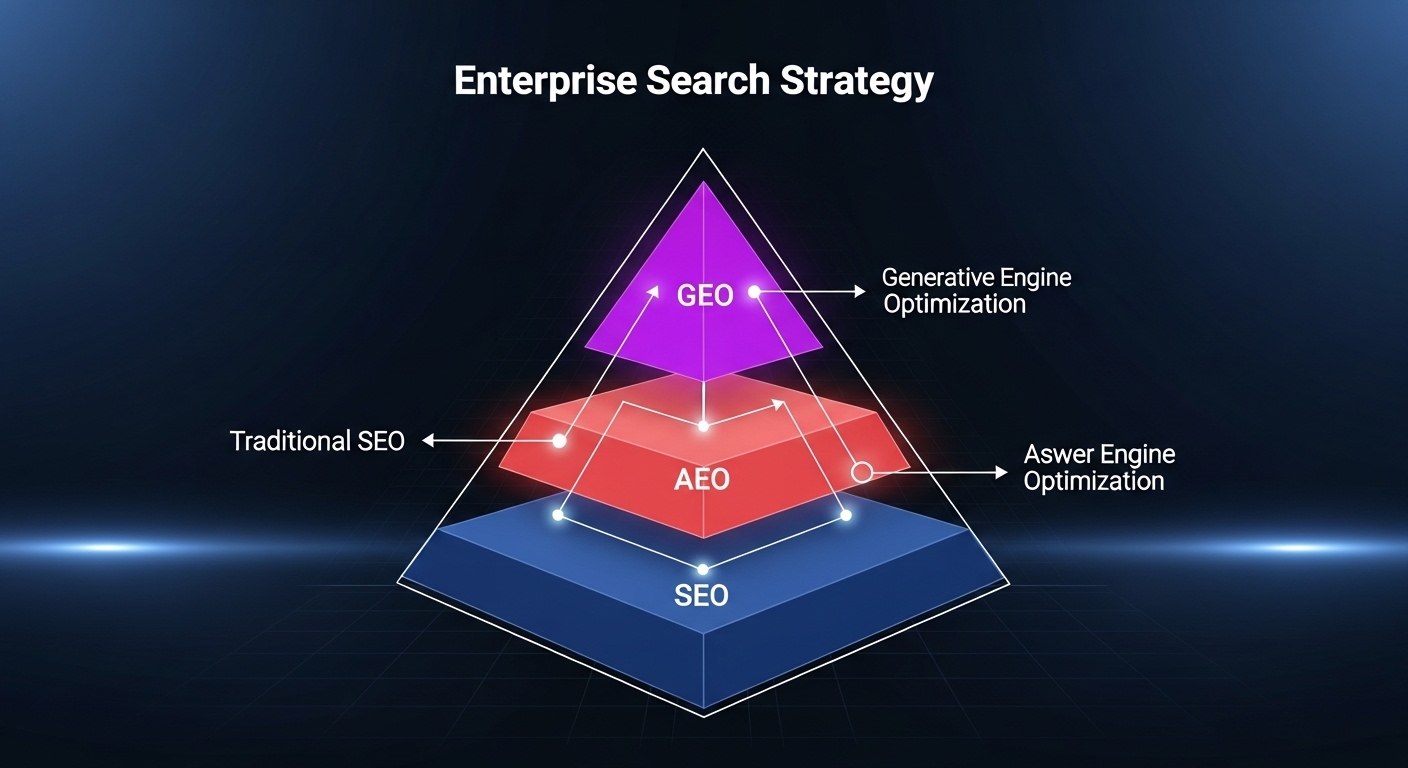
GEO sits at the intersection of three evolving search paradigms: SEO (Search Engine Optimization for traditional Google rankings), AEO (Answer Engine Optimization for featured snippets and direct answers), and GEO (optimizing for generative AI responses).
In 2026, the Philippine digital landscape has shifted dramatically. AI assistants are now primary research tools for B2B procurement decisions, property investments, and consumer purchases. [VERIFY: source needed] When a marketing director asks ChatGPT, "What are the best BPO providers in Manila for customer support?" or a homebuyer queries Perplexity about "condo developments near Makati CBD with good investment potential," the AI's response shapes their consideration set—often without them ever visiting a search engine results page.
The Evolution: From Links to Citations
Traditional SEO rewarded websites that earned the top position in Google. GEO rewards brands that become referenced sources within AI-generated answers. The goal isn't a click—it's a citation. Your brand name appears as the trusted authority, even if the user never visits your domain.
This creates a fundamental shift in how marketing teams must think about content strategy, technical implementation, and measurement frameworks.
SEO vs. GEO: Strategic Comparison for Philippine Enterprises
| Dimension | Traditional SEO | Generative Engine Optimization (GEO) |
|---|---|---|
| Primary Goal | Rank web pages in search results (positions 1-10) | Become cited as authoritative source in AI-generated responses |
| Target Platforms | Google Search, Bing | ChatGPT, Perplexity, Google AI Overviews, Meta AI, Claude |
| Content Focus | Keyword-optimized pages with backlinks | Semantic depth, structured facts, entity relationships |
| Success Metric | Organic traffic, click-through rate (CTR) | Citation frequency, brand mention in AI responses |
| Technical Priority | Page speed, mobile optimization, crawlability | Schema markup, entity resolution, knowledge graph presence |
| User Outcome | User clicks to website | User receives answer citing your brand (zero-click) |
| Philippine Context | Local keyword targeting, Google My Business | Local entity building, Tagalog/English bilingual optimization |
How Do AI Search Engines Work Differently Than Traditional Google Search?
Understanding AI search mechanics is essential for GEO strategy. Traditional search engines index web pages and rank them based on relevance signals. AI search engines operate on fundamentally different principles:
1. Retrieval-Augmented Generation (RAG)
AI search engines use Retrieval-Augmented Generation (a technique where the AI retrieves relevant information from indexed sources before generating a response). Rather than presenting a list of links, the AI synthesizes information from multiple sources and generates a coherent answer—with citations to source materials.
For your brand to appear in these responses, your content must be (a) indexed in AI training data or real-time retrieval indexes, and (b) structured in ways that signal authority on specific topics.
2. Conversational Intent Processing
Traditional search relies on keyword matching. AI search understands conversational intent (the underlying meaning and purpose behind natural language queries). A user asking, "What's the best hospital in Cebu for cardiac care?" triggers semantic understanding—not just keyword matching.
GEO requires optimizing for questions people actually ask, not just keywords they might type.
3. Entity-Based Understanding
AI engines understand entities (specific people, places, organizations, and concepts that exist in knowledge graphs). When someone searches for "BPO companies Philippines," the AI recognizes this as an entity cluster—not just a string of keywords.
Successful GEO requires establishing your brand as a recognized entity connected to relevant industry and geographic entities.
4. Multi-Source Synthesis
Unlike Google, which shows individual pages, AI search synthesizes information across sources. A single response might cite your website, a news article mentioning your brand, a directory listing, and review platforms. GEO strategy must optimize your entire brand footprint across the web—not just your owned properties.
What Are the 5 Core Tactics for GEO Success?
Implementing GEO requires a systematic approach across technical infrastructure, content architecture, and brand positioning. Here are the five foundational tactics:
1 Structured Data Implementation
Schema markup (structured code that helps search engines understand page content) is the foundation of GEO. AI engines rely heavily on Schema.org vocabulary to extract facts, relationships, and entity attributes.
- Implement Organization, LocalBusiness, and Service schemas
- Use FAQPage schema for question-answer content
- Add Article schema with author credentials and publication dates
- Connect entities using @id references and sameAs properties
2 Semantic Density & Topical Authority
Semantic density (the richness of meaning and contextual relationships within content) signals expertise to AI systems. AI engines favor content that demonstrates comprehensive understanding of a topic—not just keyword repetition.
- Create pillar content that covers topics exhaustively
- Use related terms, synonyms, and conceptually linked vocabulary
- Build content clusters that demonstrate domain expertise
- Answer questions directly with clear, factual statements
3 Citation Optimization
Citation optimization (structuring content to be easily referenced and attributed by AI systems) increases the likelihood your brand is cited in AI responses. This involves both on-page signals and off-page authority building.
- Publish original research, statistics, and proprietary insights
- Use clear attribution formatting in your content
- Earn mentions on authoritative Philippine business directories
- Maintain consistent NAP (Name, Address, Phone) across platforms
4 Entity Building & Knowledge Graph Presence
Entity building (establishing your brand as a recognized, distinct entity in AI knowledge systems) ensures AI engines understand who you are and what you do. This goes beyond SEO into brand positioning.
- Create and verify Google Business Profile and Bing Places listings
- Establish Wikipedia presence or Wikidata entries where appropriate
- Build presence on industry-specific platforms (e.g., Clutch for BPOs)
- Connect your brand to recognized parent companies, locations, and services
5 Freshness Signals & Content Currency
AI engines prioritize current information. Freshness signals (indicators that content is recent, updated, and relevant to current conditions) affect whether your content is included in AI training and retrieval.
- Update cornerstone content quarterly with current data
- Use publication and modified dates in schema markup
- Publish timely content addressing current industry developments
- Monitor and refresh pages that AI engines cite frequently
How Are Filipino Consumers Using AI Search for Purchase Decisions?
The Philippine market presents unique opportunities for GEO implementation. Filipino consumers have rapidly adopted AI assistants for research across high-consideration purchase categories. [VERIFY: source needed]
B2B Procurement: The New Research Reality
Enterprise decision-makers in the Philippines increasingly begin vendor research with AI queries. Questions like "Which BPO in the Philippines has the best employee retention?" or "Compare IT outsourcing companies in Cebu vs Manila" are answered by AI before procurement teams ever visit vendor websites.
For B2B enterprises, GEO is becoming a competitive necessity. Being absent from AI responses means being excluded from consideration sets.
Real Estate: AI as the New Property Consultant
Property buyers and investors use AI to compare developments, analyze location advantages, and validate developer reputations. [VERIFY: source needed] Queries like "Best pre-selling condos in Ortigas with good ROI" or "Is [Developer Name] reliable for property investment?" generate AI responses that heavily influence purchase decisions.
Finance & Insurance: Trust Through AI Citations
Filipino consumers researching loans, insurance policies, and investment products increasingly trust AI-synthesized comparisons. [VERIFY: source needed] Being cited as a recommended provider—or having your product features accurately represented in AI responses—directly impacts lead generation.
The Bilingual Consideration
GEO in the Philippines must account for code-switching behavior (alternating between languages in conversation). Filipino users often mix English and Tagalog in queries. Optimizing for natural language patterns—including Tagalog terms, local place names, and culturally specific terminology—improves AI visibility for the domestic market.
How Can You Audit Your Current AI Visibility?
Before implementing GEO tactics, you need baseline visibility assessment. Here's how to evaluate your current AI presence:
Step 1: Brand Mention Testing
Query major AI platforms with questions directly and indirectly related to your business:
- "What are the best [your industry] companies in the Philippines?"
- "Compare [your service category] providers in Manila"
- "[Your brand name] reviews Philippines"
- "What does [Your brand name] specialize in?"
Document whether your brand appears, how it's described, and which sources the AI cites.
Step 2: Citation Source Analysis
When AI engines cite your brand, identify the originating sources:
- Does the AI cite your website directly?
- Are citations coming from news articles or third-party directories?
- Which competitor brands appear more frequently?
- Are your citations accurate and current?
Step 3: Technical Schema Validation
Use Google's Rich Results Test and Schema.org validators to verify your structured data implementation. Check for:
- Valid JSON-LD syntax
- Complete entity relationships
- Proper organization and service markup
- Consistent entity identifiers across pages
Step 4: Knowledge Graph Verification
Search for your brand on Google and check the knowledge panel (if present). Verify accuracy of:
- Business description and industry classification
- Contact information and location
- Related entities and parent organizations
- Social profiles and official website link
→ Download: Complete AI Search Visibility Audit Checklist
What Should Your Business Do Next?
Generative Engine Optimization is not a replacement for SEO—it is an essential layer in a unified search strategy. Philippine enterprises that invest in GEO now will establish defensive positioning as AI search adoption accelerates. [VERIFY: source needed]
Your immediate priorities:
- Audit current AI visibility using the framework above to identify gaps
- Implement foundational schema markup on core commercial pages
- Optimize high-value content for question-based queries and semantic depth
- Build entity presence through authoritative directory listings and knowledge graph optimization
- Establish measurement systems to track citation frequency and brand mention quality
As a dedicated GEO agency in the Philippines, Hashmeta helps enterprises navigate this transition with technical implementation, content strategy, and AI visibility monitoring.
Ready to Secure Your AI Visibility?
Get a comprehensive assessment of your brand's presence across ChatGPT, Perplexity, Google AI Overviews, and other AI search engines.
Claim Your Free SEO & AI-Visibility AuditAvailable for Philippine enterprises. No obligation.
Extended Reading: AI Search Optimization
Three-Layer Search Strategy: SEO, AEO & GEO
Master the unified search strategy for Philippine enterprises integrating SEO, AEO, and GEO.

GEO vs SEO: What Philippine CMOs Need to Know
Executive guide on budget allocation, organizational readiness, and unified strategy for 2026.
AI Search Visibility Audit Checklist
Downloadable 15-point audit checklist for ChatGPT, Perplexity, Google AI Overviews & Meta AI.

Answer Engine Optimization: Featured in AI Overviews
Learn 6 content patterns and voice search strategies to win Google AI Overviews.

Schema Markup for AI Search: Technical Guide
JSON-LD examples, entity resolution strategies, and Philippine-specific directory connections.

Real Estate Digital Marketing: GEO & SEO Strategies
How property developers can optimize for AI search and dominate Metro Manila, Cebu, and Davao markets.


