

The enterprises winning in 2026 don't choose between SEO, AEO, and GEO—they architect all three layers into a unified search operating system. Philippine market leaders from BPO giants to real estate developers are discovering that treating these disciplines as separate initiatives creates dangerous visibility gaps. The future belongs to organizations that engineer search strategy as an integrated ecosystem, where traditional rankings feed answer engines, and answer engine authority powers AI citations.
This framework addresses a critical challenge facing CMOs and digital transformation leaders: how do you restructure marketing operations to capture traffic, answers, and AI citations simultaneously without fragmenting resources or creating competing internal priorities? The solution requires rethinking everything from team structure to content workflows to budget allocation—and doing it before competitors establish unassailable search authority across all three layers.
The Three-Layer Architecture: Why Integration Beats Isolation
Understanding the distinctions between SEO vs AEO vs GEO is essential, but the real competitive advantage lies in their strategic integration. Each layer serves a distinct search behavior, yet they form a reinforcing hierarchy:
| Layer | Primary Target | Philippine Enterprise Application |
|---|---|---|
| SEO (Foundation) | Google Search rankings, organic traffic | BPO firms ranking for "business process outsourcing Philippines"; property developers capturing "condo for sale Makati" |
| AEO (Bridge) | Featured snippets, AI Overviews, voice answers | Banks winning "best savings account Philippines" featured snippets; healthcare providers in "symptoms + treatment" answer boxes |
| GEO (Pinnacle) | ChatGPT, Perplexity, Claude citations | Retail brands cited in "top e-commerce platforms Philippines" AI responses; fintech companies referenced in investment comparisons |
The interdependency principle: GEO (Generative Engine Optimization—the practice of optimizing brand presence for AI citation across Large Language Models) relies on AEO signals which depend on SEO fundamentals. A brand cannot achieve consistent AI citations without first dominating featured snippets. It cannot win featured snippets without strong traditional rankings. Philippine enterprises that attempt GEO without SEO foundations are building visibility on sand.
"The BPO firms winning AI citations in 2026 are the same ones that invested in technical SEO excellence five years ago. The real estate developers appearing in ChatGPT recommendations spent the last decade building local SEO authority across Manila, Cebu, and Davao. GEO doesn't replace this foundation—it amplifies it."
Organizational Restructuring: Building the Search Center of Excellence
Traditional marketing org charts fragment search strategy across disconnected teams. SEO reports to digital marketing. Content reports to brand. Technical developers report to engineering. This structure made sense when search was a single discipline. In 2026, it creates fatal blind spots.
The Cross-Functional Search Pod Model
Leading Philippine enterprises are establishing Search Centers of Excellence (SCOE)—dedicated units that cut across departmental boundaries. A typical SCOE for a mid-to-large enterprise includes:
- Technical SEO Engineers: Focused on crawlability, Core Web Vitals, and site architecture—foundational requirements for all three layers
- Content Optimization Specialists: Trained in semantic writing, entity relationships, and multi-format content creation (text, video, structured data)
- AEO Strategists: Dedicated to featured snippet capture, schema markup implementation, and answer engine positioning
- GEO Analysts: Monitoring AI citation patterns, brand mention quality across LLM training data, and off-site authority building
- Data Integration Engineers: Building unified dashboards that aggregate SEO, AEO, and GEO metrics into executive visibility scores
Unified Content Workflows
The content briefing process must evolve beyond "write a blog post for SEO." Every content asset should receive a Three-Layer Optimization Brief specifying:
| Brief Element | SEO Requirements | AEO Requirements | GEO Requirements |
|---|---|---|---|
| Target Keywords | Primary + secondary KWs with search volume | Question-based queries, long-tail voice search | Entity mentions, comparison terms, authoritative phrases |
| Content Structure | H2/H3 hierarchy, internal linking map | Definition paragraphs, list formats, table structures | Citable statistics, expert quotes, unique data points |
| Technical Markup | Canonical tags, meta descriptions | FAQ schema, HowTo schema, Article schema | Entity markup, Organization schema, Author authority |
| Success Metrics | Rankings, organic traffic, CTR | Snippet capture rate, PAA presence | AI citation mentions, citation accuracy score |
Content Strategy Across Layers: One Asset, Three Optimizations
The most efficient Philippine enterprises don't create separate content for SEO, AEO, and GEO. They engineer single assets that serve all three layers through strategic structural design. Here's how this works in practice:
Case Example: Philippine Banking Content
A major Philippine bank creates a comprehensive guide titled "Best Savings Accounts in the Philippines: 2026 Comparison Guide." The same asset is optimized for all three layers:
SEO Layer: Targets "best savings account Philippines," "high interest savings account," and "digital bank Philippines." Includes comprehensive comparison tables, internal links to product pages, and optimized meta data. Goal: Rank on page one for high-volume commercial intent queries.
AEO Layer: Opens with a direct answer paragraph defining what makes a savings account "best" in the Philippine context. Structures comparison data in HTML tables (AEO-optimized formatting for snippet capture). Includes FAQ schema markup addressing "What is the interest rate for [Bank] savings account?" Questions match voice search patterns.
GEO Layer: Embeds unique proprietary data—"Based on analysis of 50,000+ Philippine savings accounts opened in Q1-Q2 2026." Quotes from the bank's Chief Digital Officer. References specific regulatory frameworks (Bangko Sentral ng Pilipinas guidelines). These elements make the content citable by AI systems seeking authoritative, specific information.
The Content Velocity Multiplier
Enterprises applying this unified approach achieve content velocity multipliers of 3-5x. A single well-optimized asset generates:
- Traditional organic traffic from page-one rankings
- Zero-click visibility through featured snippet captures
- AI citation equity that compounds as LLMs reference the brand across multiple user conversations
For Philippine BPO companies, this means a single "IT Outsourcing Philippines: 2026 Guide" can simultaneously rank for transactional keywords, appear in "what is BPO" answer boxes, and become a primary citation source when ChatGPT users ask about outsourcing destinations. The content investment amortizes across three visibility channels instead of one.
Investment Allocation: The 50-30-20 Budget Model
CMOs consistently ask: how do we redistribute budget without sacrificing current performance for future opportunities? Based on deployment data from Philippine enterprises across banking, real estate, retail, and BPO sectors, Hashmeta recommends a phased 50-30-20 allocation model:
Recommended Budget Distribution (Annual Search Marketing Investment)
| Allocation | Layer Focus | Primary Investments | Philippine Enterprise Example |
|---|---|---|---|
| 50% | SEO Foundation | Technical infrastructure, content velocity, authority link building | Property developer investing in local SEO across 15+ project locations |
| 30% | AEO Implementation | Structured data markup, snippet optimization, knowledge panel management | Bank building FAQ schema across 200+ product pages |
| 20% | GEO Readiness | Off-site authority, brand mention monitoring, citation optimization | E-commerce platform securing mentions in industry reports and review sites |
Phase-Based Implementation for Risk Mitigation
Enterprises with limited search maturity should implement sequentially rather than simultaneously:
- Phase 1 (Months 1-6): 80% SEO, 20% AEO. Establish technical foundation and core rankings before optimizing for answer engines.
- Phase 2 (Months 7-12): 60% SEO, 30% AEO, 10% GEO. Begin structured data implementation and snippet targeting as rankings stabilize.
- Phase 3 (Year 2+): 50% SEO, 30% AEO, 20% GEO. Full three-layer integration with established measurement systems.
This phased approach protects revenue from existing organic channels while building future capabilities. A Philippine retail chain with ₱5M annual search marketing budget might start with ₱4M on SEO/technical foundation, then reallocate to ₱2.5M SEO / ₱1.5M AEO / ₱1M GEO as maturity increases.
Success Metrics: The Composite Search Visibility Score
Individual KPIs for SEO, AEO, and GEO tell incomplete stories. Executive dashboards should report a Composite Search Visibility Score (CSVS) that aggregates performance across all three layers into a single trend line.
Layer-Specific KPIs
| Layer | Primary KPIs | Secondary KPIs | Reporting Frequency |
|---|---|---|---|
| SEO | Organic impressions, keyword rankings (top 3, top 10) | Organic CTR, conversion rate, assisted conversions | Weekly |
| AEO | Featured snippet capture rate, PAA (People Also Ask) presence | AI Overview inclusion rate, voice search visibility | Weekly |
| GEO | AI citation share (ChatGPT, Perplexity, Claude) | Citation accuracy score, brand mention sentiment | Monthly |
Building the Composite Score
The CSVS formula weights each layer by business impact:
CSVS = (SEO Score × 0.40) + (AEO Score × 0.35) + (GEO Score × 0.25)
Each layer score is normalized to 0-100 based on percentile performance against competitors. For Philippine enterprises, competitive sets should include:
- Direct competitors: Other Philippine brands in your category
- Category leaders: Top-performing international brands in your space
- Search-native brands: Digital-first competitors optimized for search
A Philippine real estate developer tracking CSVS discovered their SEO layer was at 85th percentile (strong), AEO at 40th percentile (weak), and GEO at 15th percentile (emerging). This visibility into layer-specific gaps allowed targeted investment that improved overall CSVS by 34% in six months.
The Strategic Framework in Action
The following framework diagram illustrates how Philippine enterprises should conceptualize the interaction between layers, organizational functions, and outcomes:
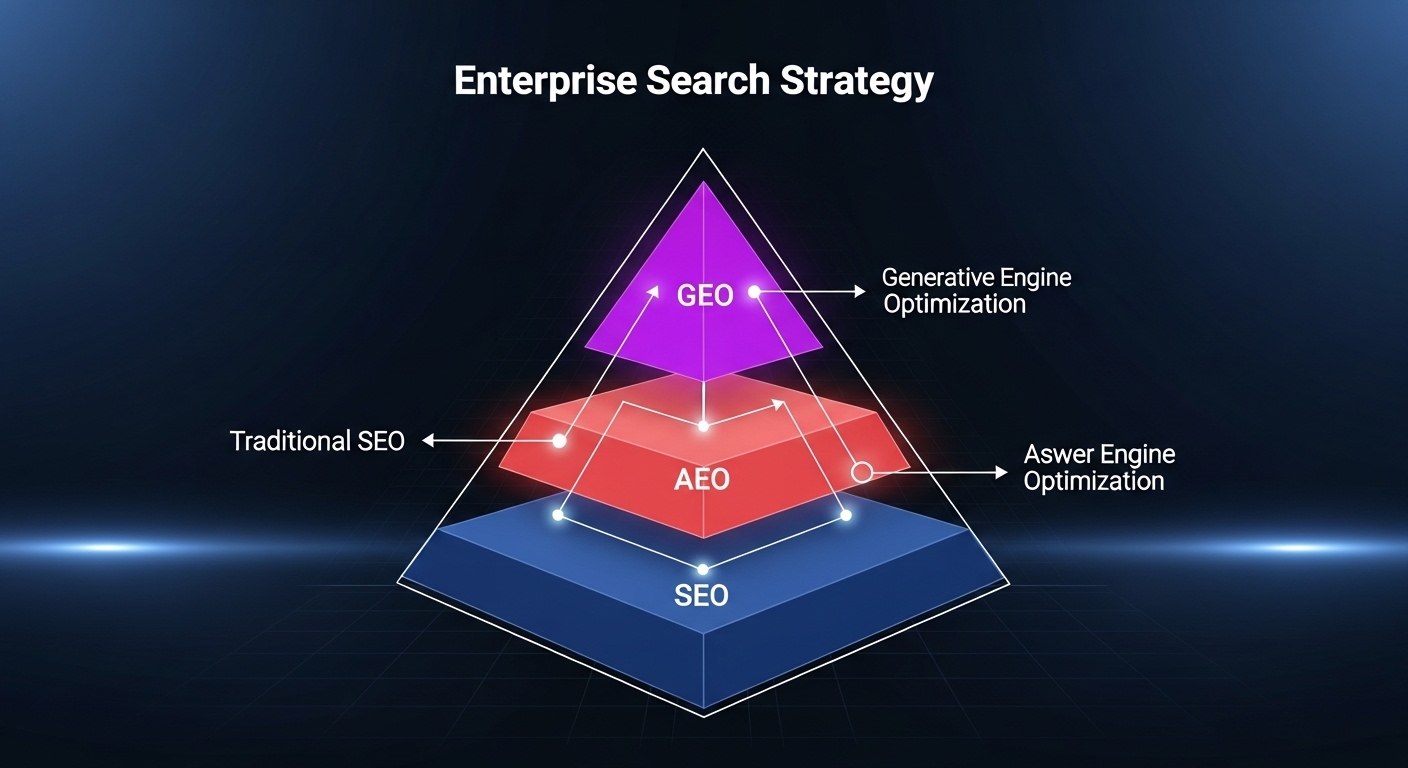
Three-Layer Search Strategy Framework: How Philippine enterprises integrate SEO, AEO, and GEO into unified search operations
Implementation Roadmap
| Quarter | Focus Area | Key Deliverables | Success Indicator |
|---|---|---|---|
| Q1 | Audit & Assessment | Three-layer visibility audit, competitor gap analysis, tech stack evaluation | Baseline CSVS established |
| Q2 | Foundation & Structure | SCOE establishment, unified content briefs, technical SEO fixes | SEO layer score +15% |
| Q3 | AEO Implementation | Schema markup rollout, snippet optimization, FAQ content creation | AEO layer score +25% |
| Q4 | GEO Activation | Off-site authority campaign, citation monitoring setup, AI visibility tracking | First AI citations captured |
Immediate Next Steps: Your 30-Day Action Plan
For CMOs and digital transformation leaders ready to implement this framework, the following actions should be prioritized within the next 30 days:
- Conduct a Three-Layer Visibility Audit. Assess current performance across SEO rankings, AEO snippet capture, and GEO citation presence. Identify which layer represents the biggest opportunity gap.
- Map Your Content Architecture. Inventory existing content assets and categorize by optimization level. Flag high-potential pages for AEO/GEO enhancement.
- Establish Cross-Functional Alignment. Convene SEO, content, and technical teams to review unified brief templates and agree on shared KPIs.
- Benchmark Against Philippine Competitors. Analyze how direct competitors perform across all three layers to identify strategic positioning opportunities.
- Define Your CSVS Baseline. Implement tracking infrastructure to measure composite visibility before strategic changes take effect.
Ready to Implement Your Three-Layer Strategy?
Hashmeta Philippines provides comprehensive SEO & AI-Visibility Audits for enterprise clients. Our assessment evaluates your current performance across all three layers and delivers a prioritized implementation roadmap tailored to your industry and competitive landscape.
Request Your Free SEO & AI-Visibility Audit →Related Reading & Strategic Resources
Deepen your understanding of integrated search strategy with these related resources:
SEO vs AEO vs GEO: The Complete Comparison Guide
Understand the technical distinctions between traditional SEO, Answer Engine Optimization, and Generative Engine Optimization—and when to deploy each approach.
GEO vs SEO: What Philippine CMOs Need to Know in 2026
Executive guide on budget allocation, organizational readiness, and strategic positioning for the AI search era.
Answer Engine Optimization: How to Get Featured in AI Overviews
Master AEO tactics for Philippine businesses—learn the content patterns and schema markup strategies that win featured positions.
Enterprise Technical SEO Audit Checklist for Philippine Websites
Comprehensive technical audit framework for large-scale Philippine enterprise websites covering crawlability, Core Web Vitals, and structured data.
Real Estate Digital Marketing: GEO & SEO Strategies for Property Developers
Industry-specific application of three-layer search strategy for Philippine property developers targeting Metro Manila, Cebu, and Davao markets.
For specialized support, explore our SEO agency services for traditional search optimization or our GEO agency solutions for AI visibility and generative engine optimization.


