
AI Visibility vs GEO vs AEO vs SEO: What’s the Difference and Which Do You Need?
Confused by SEO, AEO, GEO, and AI Visibility? Learn the key differences and discover which optimisation strategy your business actually needs.
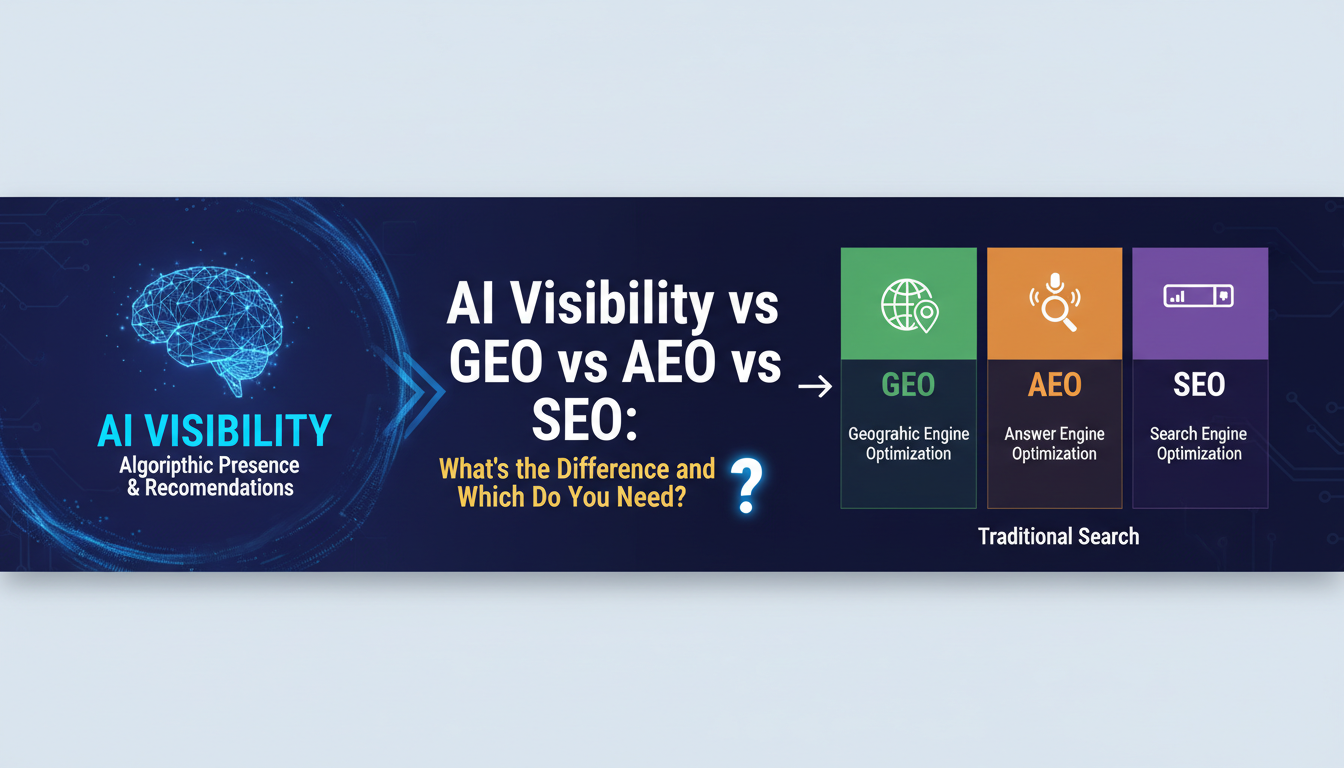
Not long ago, the digital marketing playbook had one clear north star: rank on page one of Google. Today, that’s no longer enough. A user searching for your services might never scroll past Google’s AI Overview. Another might ask ChatGPT directly and receive a confident recommendation that never mentions your brand at all. A third might query Perplexity and see three competitors cited while your website sits at position two organically.
This is the new search reality, and it’s reshaping how brands think about visibility. Terms like SEO, AEO, GEO, and AI Visibility are being thrown around constantly, sometimes interchangeably, often confusingly. Are they competing strategies? Overlapping disciplines? Or just new labels for the same old work?
In this guide, we break down each concept clearly, explain how they relate to one another, and give you a practical framework for deciding which ones deserve your attention and budget right now.
Why This Matters Now
The search game has fundamentally shifted
The Four Disciplines Explained
Distinct but interconnected — not competing
How They Stack Together
Concentric layers — not competing strategies
GEO Tactics That Move the Needle
Research-backed improvements to AI citation share
Adding citations from authoritative sources increases AI answer share by roughly 41%
Including specific data points improves citation share by around 31%
Quick Comparison
| Dimension | SEO | AEO | GEO | AI Visibility |
|---|---|---|---|---|
| Target System | Google, Bing SERPs | Featured snippets, voice, AI Overviews | ChatGPT, Perplexity, Gemini, Claude | All AI answer platforms |
| Key Tactics | Keywords, backlinks, tech health | FAQ schema, answer-first structure | Entity consistency, off-site signals | Citation tracking, share of voice |
| Success Metric | Rankings & organic traffic | Snippet wins & citations | Citation share across platforms | AI brand mention rate & accuracy |
| Drives Clicks? | Yes, primarily | Sometimes | Sometimes + awareness | Indirect via brand trust |
Which Do You Need?
Use this decision guide to prioritise your investment
5 High-Leverage Actions
That benefit all four disciplines simultaneously
Build Up from Your Biggest Gap
SEO is the non-negotiable foundation. AEO structures your content for extraction. GEO earns your place in the broader AI narrative. AI Visibility measures how well all three are working. The brands winning in modern search don’t chase the latest acronym — they build all four layers systematically.
Why This Question Matters Right Now
The scale of change in search behaviour is difficult to overstate. According to research published in 2025 and 2026, organic CTR on queries with AI Overviews has fallen by 61% compared to queries without them. When an AI Overview appears on a results page, only 8% of users click a traditional organic result, versus 15% on pages without AI summaries. For publishers and content-heavy brands, some verticals have seen organic session declines of 30–47%.
But here is the nuance most people miss: being cited within AI-generated answers reverses much of that damage. Brands cited in AI Overviews earn 35% more organic clicks and 91% more paid clicks than non-cited competitors. The game has not ended. It has simply moved to a different playing field, and understanding the difference between SEO, AEO, GEO, and AI Visibility is the first step to competing on it.
What Is SEO?
Search Engine Optimization (SEO) is the practice of improving your website’s visibility in search engine results pages (SERPs) so that more people find and visit your site organically. It encompasses keyword research, content creation, backlink acquisition, technical site health, and on-page optimisation, all designed to signal relevance and authority to search engine algorithms.
SEO is the foundation on which everything else is built. Strong domain authority, well-structured content, and a clean technical architecture are prerequisites for every other optimisation discipline discussed in this article. Without a solid SEO base, efforts in AEO, GEO, or AI Visibility tend to underperform because the underlying signals that AI systems rely on, such as domain credibility, authoritative content, and structured data, come directly from good SEO practice.
If you are looking to build or improve that foundation, Hashmeta’s SEO Agency services and SEO Consultant programmes are designed for exactly that purpose, covering everything from Local SEO to full-scale SEO service delivery.
What Is AEO (Answer Engine Optimization)?
Answer Engine Optimization (AEO) is the practice of structuring and formatting your content so that it gets extracted and cited directly in AI-generated answers and voice search responses. Where traditional SEO gets your page into the results list, AEO gets your content into the answer itself. Think of Google’s featured snippets, People Also Ask boxes, and voice assistant responses as the original AEO surfaces, later expanded to include AI Overviews and conversational AI tools.
AEO prioritises extractability. Content optimised for AEO typically leads each section with a concise, standalone answer, uses FAQ-style formatting, incorporates structured data markup (schema.org), and targets the specific questions users ask rather than just the keywords they type. The underlying goal is to make it as easy as possible for an AI system to pull your answer and serve it directly to a user at the moment of need.
It is worth noting that AEO grew out of the featured-snippet era and was designed for structured, answer-first interfaces. As AI tools like ChatGPT, Gemini, and Perplexity have become mainstream discovery channels, AEO has evolved alongside them. Hashmeta’s dedicated AEO services are built around this evolution, helping brands optimise for citation across both traditional SERP features and modern AI answer surfaces.
What Is GEO (Generative Engine Optimization)?
Generative Engine Optimization (GEO) takes the principles of AEO and expands them into the broader AI ecosystem, where answers are synthesised from multiple sources rather than simply extracted from a single page. Platforms like ChatGPT, Perplexity, Claude, and Google AI Overviews do not just pull a quote from one article. They assemble narratives from training data, third-party mentions, reviews, forums, and authoritative publishers. GEO is the practice of ensuring your brand appears consistently and favourably throughout that ecosystem.
The practical difference between AEO and GEO is a useful one to understand. AEO optimises for extraction of your existing content at the moment a user asks a question. GEO optimises for how your brand exists within what AI models already know, including their training data biases, the external sources that reference you, and your cross-platform entity consistency. A 50-word featured snippet optimised for AEO may not be enough for a generative AI to cite you confidently; GEO requires broader, deeper coverage of your topic and a visible presence across trusted third-party sources.
Research on GEO tactics has produced some illuminating findings. Adding quotations from credible sources increases a brand’s share of AI-generated answers by roughly 41%, while including clear statistics improves it by around 31%. GEO also requires monitoring success across multiple platforms, since performing well in Google’s AI Overviews does not automatically translate to visibility in ChatGPT or Perplexity. Hashmeta’s GEO services address this multi-platform challenge with a structured approach to entity authority, off-site presence, and AI-native content strategy.
What Is AI Visibility?
AI Visibility is best understood as both a metric and an overarching goal. Where GEO describes the optimisation practice, AI Visibility describes the outcome you are measuring: how often, how accurately, and how prominently your brand appears in responses generated by AI-powered search engines and assistants. It is the question of whether the AI mentions you when a user asks about your category, product, or service.
Traditional SEO visibility asks: “Where does my page rank in Google’s results?” AI Visibility asks a different question entirely: “Does the AI mention my brand when someone asks about my topic?” These are related but distinct. You can rank position one on Google while being entirely absent from ChatGPT’s recommendations. Conversely, a brand with a moderate organic ranking but strong off-site authority and consistent entity signals may be cited frequently by AI tools.
The signals that drive AI Visibility include entity coherence across the web, semantic depth in content, cross-platform brand mentions (linked and unlinked), information gain (unique data points not widely available elsewhere), and E-E-A-T signals that help AI models assess trustworthiness. Tools like Hashmeta’s AppearSearch platform are designed specifically to help brands track and improve this kind of AI-era visibility across search surfaces.
Side-by-Side: SEO vs AEO vs GEO vs AI Visibility
The table below distils the key differences across all four disciplines to give you a clear reference point before diving into strategy decisions.
| Dimension | SEO | AEO | GEO | AI Visibility |
|---|---|---|---|---|
| Primary Goal | Rank higher in search engine results pages | Get content extracted into direct AI and voice answers | Get cited by generative AI systems across multiple platforms | Measure and improve brand presence in AI-generated answers |
| Target System | Google, Bing (SERPs) | Featured snippets, voice assistants, AI Overviews | ChatGPT, Perplexity, Gemini, Claude, AI Overviews | All AI answer platforms (tracked as an outcome metric) |
| Key Tactics | Keywords, backlinks, technical health, on-page structure | FAQ schema, concise answers, question-format headings, structured data | Entity consistency, off-site brand mentions, credibility signals, semantic depth | AI-facing infrastructure, citation tracking, brand mention monitoring |
| Success Metric | Rankings, organic traffic, CTR | Snippet wins, citation appearances, voice answer placements | Citation share across AI platforms, brand mention rate | AI brand mention rate, citation accuracy, share of voice in AI responses |
| Drives Clicks? | Yes, primarily | Sometimes (featured snippets), less so in zero-click AI answers | Sometimes (citation links); primarily builds awareness and trust | Indirect (brand awareness and credibility that convert later) |
| When It Emerged | Late 1990s, continuously evolving | Mid-2010s (featured snippets, voice search era) | 2023–present (generative AI era) | 2024–present (AI search maturation) |
How They Work Together (Not Against Each Other)
One of the most common misconceptions is that these disciplines compete with each other. They do not. Think of them as concentric layers of a modern visibility strategy, with SEO forming the core and each subsequent layer extending your reach into additional surfaces where your audience discovers brands.
Strong SEO builds the domain authority and technical health that AI systems use as a primary trust signal. AEO structures your content so that AI tools can extract and serve it efficiently. GEO ensures your brand is part of the broader information ecosystem that generative models draw from when constructing answers. And AI Visibility is the measurement layer that tells you how well all of the above is working in AI-native environments. Each layer depends on the ones beneath it. Chasing GEO without a healthy SEO foundation, for example, is like building on sand.
The practical implication is that the best approach is not to choose one discipline over the others but to build upward from a solid base. Content Marketing that is created with SEO fundamentals, structured for AEO extraction, enriched with the credibility signals GEO requires, and tracked against AI Visibility metrics will outperform content that optimises for any single layer in isolation. This integrated approach is exactly what Hashmeta’s AI SEO and AI Marketing services are built around.
Which One Do You Actually Need?
The honest answer is: it depends on where your audience is in the buying journey and which search surfaces they actually use. Here is a practical framework to guide your prioritisation.
Start with SEO if…
- You are building your digital presence from scratch and have low domain authority
- Your target audience primarily discovers brands through traditional Google searches
- You rely on organic search as a primary traffic and lead-generation channel
- Your technical site health is poor (slow load times, indexing issues, broken structure)
- You have not yet built a content library with keyword-targeted, well-structured articles
Layer in AEO if…
- You have a functioning SEO foundation and want to capture more zero-click real estate
- Your content answers specific, common questions in your industry
- You are competing in verticals where AI Overviews frequently appear (Healthcare, B2B Tech, Education)
- Voice search is a meaningful channel for your audience (local services, consumer-facing brands)
- You want to be cited inside ChatGPT, Perplexity, or Google’s AI answers when users ask about your category
Invest in GEO if…
- Your brand is not appearing in AI-generated answers despite having reasonable organic rankings
- You operate in a high-consideration category where buyers research extensively on AI platforms before contacting vendors
- Your off-site brand presence (reviews, mentions, earned media) is weaker than your on-site content
- You are targeting buyers at the research and shortlisting stage, before they even formulate a search query
- You want consistent, accurate brand representation across ChatGPT, Gemini, Perplexity, and Claude simultaneously
Track AI Visibility if…
- You are investing in any combination of the above and want to measure the impact on AI-native surfaces
- You need to benchmark your AI citation rate against competitors
- You have noticed a disconnect between your organic rankings and your presence in AI tools
- You want to understand which AI platforms favour your content and which ones do not
For most established brands, the answer is to pursue all four in an integrated programme, scaled according to current gaps. A business with strong SEO but no AI presence should prioritise AEO and GEO next. A newer brand with an undeveloped organic presence should start at the SEO layer and build systematically. Hashmeta’s AI marketing agency team works through exactly this kind of prioritisation analysis with clients across Singapore, Malaysia, Indonesia, and China.
How to Optimise for All Four: Key Actions
While each discipline has its own specific tactics, several actions benefit all four simultaneously. These are the highest-leverage investments for any brand navigating the modern search landscape.
1. Build content with original data and genuine expertise
AI systems across every platform favour content that is evidentiary: content backed by original research, real-world experience, expert quotes, and accurate statistics. This kind of content earns backlinks for SEO, gets extracted for AEO, earns citations for GEO, and improves AI Visibility all at once. Generic, surface-level content that rehashes what is already widely available will underperform in every discipline.
2. Structure every piece for extraction
Use clear H1-H2-H3 hierarchies, lead each section with a direct and complete answer to the heading’s question, apply relevant schema markup (FAQ, HowTo, Article, Review), and keep key statements free of pronouns or references that only make sense with surrounding context. This structure improves both your SERP ranking and your extractability for AI answers.
3. Build your entity presence across trusted platforms
Make sure your brand name, products, services, and value proposition are described consistently across your own site, Google Business Profile, industry directories, review platforms, and earned media placements. AI models learn about brands from the web’s consensus about them. Inconsistent naming, conflicting descriptions, or a weak off-site presence creates confusion that reduces citation likelihood. This is also where Influencer Marketing and Hashmeta’s AI Influencer Discovery tool can play a direct role in building credible off-site brand signals.
4. Keep content fresh and factually current
AI retrieval systems prefer recently updated content, particularly on topics where information changes quickly. Regular content audits that update statistics, refresh examples, and remove outdated references signal recency to both traditional search algorithms and AI retrieval mechanisms. This is not about cosmetic date changes; the content itself needs genuinely new information to earn the recency benefit.
5. Measure AI citation separately from organic rankings
Your Google rank and your AI citation rate are related but not the same thing. Track them separately. Use tools designed to monitor how your brand appears across ChatGPT, Perplexity, Gemini, and Google AI Overviews, and compare your citation share against competitors across your priority topics. If your rankings are strong but AI citations are low, the gap signals a GEO opportunity. If you are cited frequently but driving low traffic, your AEO content structure may need attention.
For brands looking to build this kind of integrated visibility from the ground up, Hashmeta’s AI Agency services bring together SEO, AEO, GEO, and AI Visibility tracking into a single performance-driven programme. This is supported by tools like LocalLead for AI-powered local business discovery, and Hashmeta’s broader suite of Website Design and technical infrastructure services that underpin all search performance.
Frequently Asked Questions
Is GEO replacing SEO?
No. GEO is an additional layer of visibility strategy, not a replacement for SEO. Strong organic rankings and domain authority remain the foundation that AI systems use to determine which sources to trust. GEO extends that foundation into AI-native surfaces where traditional SEO signals alone are not sufficient.
Are AEO and GEO the same thing?
They are closely related but distinct. AEO emerged during the featured-snippet and voice-search era and focuses on getting specific pieces of your existing content extracted into direct answers. GEO was developed specifically for the generative AI era and focuses on ensuring your brand is part of the broader information ecosystem that AI models draw from when synthesising multi-source responses. AEO is about extraction; GEO is about earning your place in the narrative AI systems build.
Can you optimise one page for SEO, AEO, and GEO simultaneously?
Yes, and you should. A well-structured page with original research, clear headings, answer-first sections, schema markup, and consistent entity language will benefit all three disciplines at once. The same signals that help a page rank organically also make it more extractable for AEO and more citable for GEO. The disciplines share a common foundation even when their specific emphasis differs.
What is AI Visibility and how do I measure it?
AI Visibility is the measure of how often and how accurately your brand appears in AI-generated answers across platforms like ChatGPT, Perplexity, Gemini, and Google AI Overviews. You measure it by tracking brand citations, citation accuracy, share of voice in AI responses for your priority topics, and how your appearance compares to competitors across those same prompts. It is the outcome metric that tells you whether your SEO, AEO, and GEO efforts are producing results in AI-native channels.
How does Xiaohongshu factor into an AI Visibility strategy?
For brands targeting Chinese-speaking audiences across Southeast Asia and China, platforms like Xiaohongshu (Little Red Book) are increasingly influential sources that shape what AI models surface when users ask about products and services in those markets. Building a credible brand presence on Xiaohongshu contributes to the off-site entity signals that GEO and AI Visibility depend on. Hashmeta’s Xiaohongshu Marketing services are designed to integrate these platform-specific signals into a broader AI visibility strategy.
The Bottom Line
SEO, AEO, GEO, and AI Visibility are not competing methodologies to be debated. They are progressive layers of a modern search strategy, each one building on the last. SEO remains the non-negotiable foundation. AEO ensures your content is structured to be extracted when AI systems serve direct answers. GEO earns your place in the broader narrative AI models construct from across the web. And AI Visibility gives you the measurement framework to know how well each layer is performing where it counts most.
The brands that will win visibility in 2026 and beyond are not those who chase the latest acronym but those who build an integrated programme that addresses all four layers systematically, starting where their current gaps are largest. If you are unsure where to start or want an expert team to audit your current position and map out a prioritised strategy, the Hashmeta team is ready to help.
Ready to Build Your AI Search Visibility Strategy?
Hashmeta’s team of 50+ in-house specialists has helped over 1,000 brands across Singapore, Malaysia, Indonesia, and China navigate exactly this kind of strategic complexity. Whether you need an SEO audit, an AEO content overhaul, a GEO programme, or a full AI Visibility tracking setup, we can build a performance-driven solution tailored to your market and goals.