
Schema, Entities and Citations: The Technical Checklist for AI Search
Master AI search visibility with this technical checklist covering schema markup, entity-building, crawl access, and citation strategies for GEO and AEO success
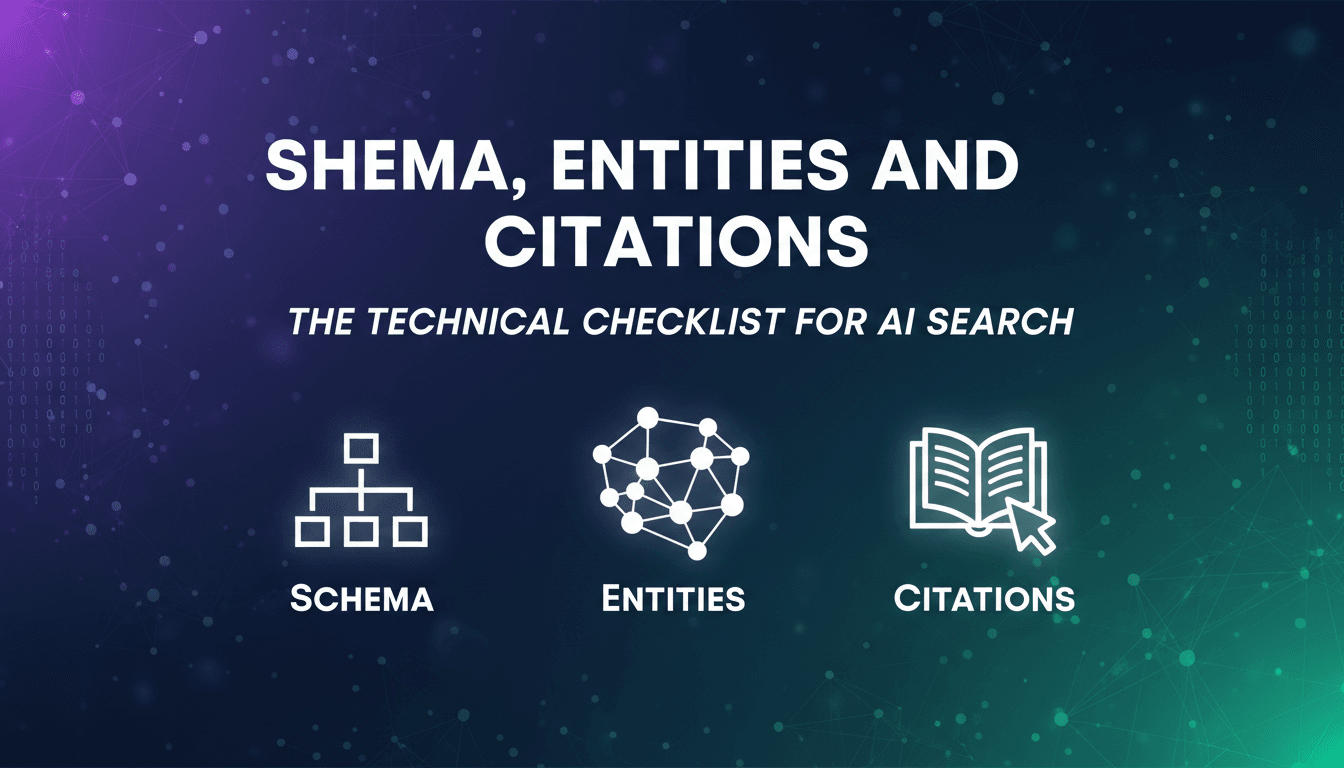
Search in 2026 no longer ends with a list of blue links. Google AI Overviews, ChatGPT, Perplexity, Gemini, and Microsoft Copilot now synthesise answers directly, and the brand that earns a citation inside that answer has effectively captured the conversion event — often before a user ever clicks through to any website. This is a structural shift, not a trend, and it demands a genuinely different technical mindset.
The challenge is that the market is flooded with oversimplified advice: add FAQPage schema and you’ll triple your citations; ship an llms.txt file and the AIs will come running. The reality, backed by rigorous 2026 research, is more nuanced and frankly more interesting. Schema markup is valuable infrastructure but not a standalone citation lever. Entity clarity — how clearly AI systems can recognise who you are and what you stand for — is a far more powerful signal. And crawl access, so mundane it barely makes headlines, is the foundational prerequisite that everything else depends on.
This guide cuts through the noise with a practical, evidence-based technical checklist built around three pillars: schema and structured data, entity building, and crawl access and citation authority. Whether you are running a growing brand across Southeast Asia or managing technical SEO for an enterprise site, these are the checks that determine whether AI engines can find you, understand you, and trust you enough to cite you.
What AI Engines Need From You
Pillar 1
Schema Markup
Infrastructure for AI indexing — not a citation shortcut. JSON-LD only. Priority types: Organization, FAQPage, Person, Product
Pillar 2
Entity Building
Train AI to recognise your brand as a unique, trusted node. Consistency across all platforms = AI’s default answer
Pillar 3
Crawl Access
The non-negotiable entry fee. Blocking AI crawlers silently deletes you from the fastest-growing citation channel
Research-Backed Data Points
Schema Types That Actually Matter
Organization Schema
Your brand entity anchor. Use sameAs to link LinkedIn, Crunchbase & social profiles
Must Have
FAQPage Schema
Highest citation lift of all schema types — matches AI answer extraction format exactly
High Impact
Person Schema
Named, resolvable author entities improve retrieval rates vs generic bylines
E-E-A-T Signal
Product / Service Schema
Attribute-rich (pricing, ratings, specs) outperforms generic schema — especially for lower-authority domains
Commercial Win
⚡ JSON-LD only — keeps markup separate from HTML so AI crawlers parse without interference
Know Your AI Crawlers
Training bots ≠ Search bots — blocking one does NOT block the other
⚠️ Blocking Google-Extended doesn’t hurt traditional rankings — but silently removes you from AI Overviews that appear on 25–65% of searches
3-Tier Implementation Checklist
Crawl Access & Indexation — Do This First
Schema & Entity Signals — Build Second
sameAs linksdateModified & linked Author@id into entity graphCitation Authority & Measurement — Maintain Continuously
Content Structure That Gets Cited
Direct Answer
First paragraph
Supporting Context
Body content
Examples
Throughout
Evidence
Research & data
💡 74.9% of AI-cited sentences appear in the first half of the document — lead with your best content
The Core Principle
Make your content technically accessible, make your brand unmistakably identifiable, and make your expertise genuinely worth citing.
Infographic by Hashmeta · Asia’s AI-Powered Digital Marketing Agency · Singapore · Malaysia · Indonesia
Why Technical AI SEO Is Different in 2026
Traditional technical SEO was always about helping Googlebot crawl, render, and index your pages. That mission has not disappeared — if anything, it has become more consequential. Google’s own AI optimisation guide confirms that AI Overviews and AI Mode are rooted in the same core Search ranking and quality systems as regular search. A blocked robots.txt directive, a misconfigured canonical, or a slow server response does not just hurt your blue-link rankings anymore; it removes your content from the pool of pages Google’s AI considers when writing an answer.
What is genuinely new is the scope. AI search now operates across multiple platforms simultaneously — Google AI Overviews, ChatGPT, Perplexity, Gemini, and Claude — and each has its own crawler, its own indexing logic, and its own citation behaviour. Where traditional SEO was largely a first-party game optimised on your own website, AI visibility is substantially a third-party game. Research from 2026 suggests that roughly 85% of brand mentions in AI-generated responses originate from third-party pages, not brand-owned content. That fundamentally changes what “technical SEO” means: it now includes how your brand is represented across the entire web ecosystem, not just your own domain.
Understanding this broader scope is the starting point for Generative Engine Optimization (GEO) and Answer Engine Optimization (AEO) — two disciplines that sit above traditional SEO in the AI visibility stack. SEO builds the foundation of indexation and authority. AEO structures that foundation for direct answer extraction. GEO extends both into citation authority and brand recommendation across the full generative AI ecosystem. All three are now necessary, and the technical checklist in this article addresses all three layers.
Pillar 1: Schema Markup — Infrastructure, Not a Magic Bullet
Schema markup is frequently oversold in the context of AI search. Claims that it can “3x your citations” or “dramatically boost AI visibility” circulate widely, but the most rigorous available research tells a more careful story. The 2026 Ahrefs controlled study tracked 1,885 pages that added JSON-LD schema over a seven-month period against a matched control set of roughly 4,000 pages that did not. The result: no statistically meaningful increase in AI citations across Google AI Overviews, Google AI Mode, or ChatGPT. A separate cross-platform empirical study published in February 2026 found that Google organic rank position remains the dominant predictor of AI citation, with schema alone providing no independent lift for generic types like Article or Organisation.
None of this means schema is a waste of effort. It means the reason to implement it needs to be accurate. Schema markup does three concrete jobs in an AI search context. First, it earns traditional rich results — star ratings, FAQ dropdowns, breadcrumb trails — that improve click-through rates and feed the search indexes that AI products draw from. Second, when AI agents do parse structured data, typed entities and Q&A pairs allow them to extract facts without inferring them from prose. Third, for pages that AI systems have not yet encountered, schema can accelerate crawling, parsing, and initial indexation. The honest framing from Google’s own guidance: structured data “isn’t required for generative AI search” but is worth continuing as part of an overall SEO strategy.
One important nuance from the cross-platform research: attribute-rich schema that provides extractable factual content — specifically Product or Review schema with populated fields like pricing, aggregateRating, and specifications — was cited at substantially higher rates than pages using generic schema types. That advantage was most pronounced for lower-authority domains, suggesting that factual payload in structured data can partially compensate for weaker domain authority signals. For brands building their online presence across competitive Asian markets, this is a meaningful tactical insight.
The Schema Types That Actually Matter
Prioritising schema implementation by what it delivers — rather than what it promises in theory — narrows the list considerably. The following types carry the most practical value for AI search contexts in 2026, based on documented platform guidance and available citation research.
- Organization schema — The anchor of your brand entity. Deploy this on your homepage with a stable
@id, your brand name, logo, URL, and social profiles linked viasameAs. This is the node AI systems reference when resolving who you are. - FAQPage schema — The highest-performing schema type for direct citation lift because AI answer engines extract and present content in question-answer format. Each FAQ pair should match a visible heading in your page content; schema that marks up content not visible on the page is flagged as misleading by Google.
- Article or BlogPosting schema — Establishes content type, authorship, and freshness signals. The two fields that matter most for AI citation are
dateModified(freshness) and a linkedauthorPerson entity (credibility). Pages that force AI systems to infer publication dates and authorship create uncertainty that reduces citation confidence. - Person schema — Identifies the named expert behind your content. Research from May 2026 found that pages with resolvable author entities were retrieved at higher rates than those with generic bylines. Linking author schema to external profiles like LinkedIn strengthens the entity record.
- Product or Service schema — Essential for commercial pages. Populate concrete attribute fields (pricing, aggregateRating, specifications) rather than leaving them empty; attribute-rich implementations outperform generic ones in citation research.
- LocalBusiness schema — Critical for businesses with physical locations or regional service areas. Consistency between schema declarations and third-party listings (Google Business Profile, directories) is a trust signal for AI systems evaluating entity reliability. This is especially relevant for local SEO across markets like Singapore, Malaysia, and Indonesia.
Implementation format matters. JSON-LD is the only serious choice for AI search optimisation in 2026. It keeps markup separate from your HTML content, making it easier for AI crawlers to parse without interference from your page structure. Microdata and RDFa embed schema inside HTML tags and create parsing conflicts when AI engines process rich text. Use JSON-LD consistently, validate every implementation in Google’s Rich Results Test, and connect your schema nodes into a coherent graph using @id references rather than leaving them as disconnected blocks.
Pillar 2: Entity Building — Training AI to Recognise Who You Are
Before a generative AI system can cite your content, recommend your product, or include your brand in an answer, it needs to resolve one fundamental question: who are you? In AI systems, an entity is a clearly defined, uniquely identifiable thing — a company, product, person, or idea — that can be distinguished from others and connected to related information. Large language models organise knowledge through entities and their relationships, not through keywords. This means the brands that consistently win in AI search are those that have trained the AI to recognise them as a distinct, trusted entity — not those who have simply published the most content.
Entity building operates across two layers. The first is entity recognition: making sure AI systems can correctly identify your brand as a unique node in their knowledge graph, associated with the right services, locations, and areas of expertise. The second is brand authority: ensuring that once recognised, your brand is evaluated as credible and trustworthy enough to cite. Both layers require deliberate action across your own website and across the third-party web. Research confirms that LLMs frequently apply a form of “majority rule” for brand facts — if multiple independent, authoritative sources describe your brand consistently, that description becomes the AI’s default answer.
The practical steps for entity building centre on consistency and coverage. Audit how your brand is described across your website, social profiles, directory listings, and third-party mentions. Standardise your brand name, service categories, geographic presence, and key differentiators so that every source tells the same story. Use the sameAs property in your Organisation schema to link your homepage entity to your LinkedIn, Crunchbase, and any other authoritative profiles. Pursue earned media coverage from sources that are themselves confirmed Knowledge Graph nodes — press coverage from respected industry publications carries higher entity signal weight than generic backlinks. For brands operating across the APAC region, this means ensuring regional platforms, local business directories, and language-specific profiles are equally consistent.
Author entities deserve specific attention. Named, schema-attributed authors whose entity records are resolvable produce better AI citation rates than content attributed to generic bylines or organisations. This aligns with the broader E-E-A-T framework (Experience, Expertise, Authoritativeness, Trustworthiness) that AI systems use to evaluate source credibility. Building genuine topical authority — a body of interconnected, expert-led content that leaves no major question in your niche unanswered — remains the strongest predictor of AI citation according to research from Princeton University and IIT Delhi, explaining 17% of citation variance compared to less than 4% for domain authority alone.
Pillar 3: Crawl Access — Letting the Right Bots In
All the schema and entity work in the world delivers nothing if AI crawlers cannot reach your content. Crawlability is the prerequisite — not the differentiator, but the entry fee. This is where many technically capable sites quietly lose AI visibility without realising it. CDN security settings, WAF rules, and default “block AI bots” configurations in modern hosting platforms can silently exclude entire AI crawlers from your site. The result: your content is invisible to AI search, regardless of how well it is structured or how authoritative your brand is.
The 2026 AI crawler landscape is more complex than it appears because major AI providers now run separate bots for training versus live search. OpenAI operates GPTBot (training) and OAI-SearchBot (search citations) as distinct crawlers. Anthropic runs ClaudeBot (training) separately from Claude-SearchBot (search). Blocking GPTBot does not remove you from ChatGPT search, and vice versa. The strategic decision for most brands is to allow search and retrieval crawlers — OAI-SearchBot, Claude-SearchBot, PerplexityBot — while having an informed, deliberate policy about training crawlers. Blocking AI search crawlers to protect your content from training inadvertently deletes you from the fastest-growing citation channel of 2026.
Google’s AI ecosystem adds a further nuance. Google-Extended is the crawler specifically responsible for AI Overviews and Gemini, and it is entirely separate from Googlebot. Blocking Google-Extended does not affect your traditional search rankings, but it does remove you from AI Overview citations — which now appear on roughly 25–65% of searches depending on the query type. Since AI Overviews are now among the most visible elements in Google Search results, inadvertently blocking Google-Extended is a significant, often invisible traffic leak.
Your technical SEO crawl access checklist should cover the following areas without exception:
- Review your robots.txt file for explicit directives covering each major AI crawler (GPTBot, OAI-SearchBot, ClaudeBot, Claude-SearchBot, PerplexityBot, Google-Extended). Absence of a directive means the bot follows your default User-agent: * rules — which may or may not be what you intend.
- Check your CDN and WAF bot-management settings. Many platforms (Cloudflare, AWS, Fastly) offer one-click “block AI bots” options that can inadvertently block search crawlers alongside training crawlers.
- Confirm that your critical page content is rendered in server-side HTML, not dependent on client-side JavaScript. Many AI crawlers do not execute JavaScript the way Googlebot does. If your main content only appears after JS renders, those crawlers see a blank page.
- Search server logs for AI user agents (OAI-SearchBot, ChatGPT-User, PerplexityBot, ClaudeBot) receiving 403, 429, or challenge page responses — these indicate crawlers that are attempting to access your content but being blocked at the infrastructure level.
- Use Google Search Console’s Search Generative AI control (Settings → Search Generative AI) to confirm your site is not unintentionally excluded from AI Overviews, AI Mode, and AI Overviews in Discover.
Citations and Topical Authority: The Real Citation Drivers
Schema and crawl access create the conditions for AI citation. Topical authority and content quality are what determine whether the citation actually happens. The research is consistent across multiple independent studies: pages that answer the main question directly, cover related angles comprehensively, and demonstrate genuine expertise are cited far more frequently than pages that are technically well-structured but substantively thin. A page at organic position 6 with strong topical authority signals is cited by AI engines 2.3 times more frequently than a page at position 1 with weak topical authority.
What does this mean practically for your content strategy? First, structure content in layers: lead with the direct answer, then provide supporting context, then add examples, then supply evidence. AI systems extract content in passage-level chunks, and the first half of your document is cited far more frequently than the second — research from May 2026 found that 74.9% of cited sentences appeared in the first half of analysed documents. Second, freshness is a meaningful signal for time-sensitive topics. Content older than 90 days begins to lose retrieval priority for rapidly evolving queries. Regular updates with accurate dateModified schema keep your content in active consideration.
Digital PR has emerged as the primary off-site lever for AI citation authority. Being cited by authoritative industry publications creates the trust neighbourhoods that AI models use to evaluate credibility. In traditional SEO, unlinked brand mentions were largely irrelevant. For GEO and AEO purposes, authoritative unlinked mentions are meaningful entity signals — AI systems evaluate brand credibility through the breadth and quality of third-party references, not just dofollow backlinks. Building a programme of original research, proprietary data, and expert commentary that earns genuine press coverage is now as important as any on-page technical optimisation. This is precisely why agencies like AI marketing specialists approach visibility as an ecosystem discipline rather than a purely technical one.
llms.txt: Useful Infrastructure or Overhyped File?
The llms.txt file — a plain markdown document at your domain root that describes your site’s content hierarchy to AI systems — has attracted significant attention in 2026. The honest assessment: it is not an AI search citation lever, but it is not worthless either. Analysis of over 500 million LLM bot traffic events found that AI search crawlers including GPTBot, ClaudeBot, PerplexityBot, OAI-SearchBot, and Google-Extended are almost never fetching /llms.txt — they overwhelmingly crawl HTML directly instead. Google has officially confirmed that it does not use llms.txt for Google Search, AI Overviews, or AI Mode.
What llms.txt does provide is a machine-readable navigation guide for AI agents operating in what practitioners are calling the “agentic web” — systems like IDE assistants, MCP servers, and in-product AI tools that do fetch the file when exploring a site’s content hierarchy. The distinction is robots.txt grants or denies access; llms.txt curates what is worth reading among what is accessible. For brands with plausible agent-driven use cases — vendor research, comparison shopping, service documentation — a well-structured llms.txt is low-cost infrastructure worth having. For most brands, it should be the last item on the checklist rather than the first.
Measuring Your AI Search Visibility
One of the most important practical challenges in AI search optimisation is measurement. AI-driven visibility does not show up cleanly in Google Analytics or Google Search Console. A user may ask ChatGPT which SEO consultant to hire in Singapore, receive your brand as a recommendation, and conduct a branded search days later — a conversion that appears in your analytics as direct or branded organic traffic, with no visible AI attribution. Research confirms that roughly 90% of brands currently have zero mentions in AI search results across major platforms, which means establishing a monitoring baseline is an urgent first step, not a future consideration.
Effective AI visibility measurement requires a parallel monitoring layer alongside traditional analytics. Run structured prompt tests across ChatGPT, Perplexity, Gemini, and Google AI Mode monthly — queries that include your brand name alone, your brand plus primary service category, and “what does [brand] do” style questions. Document citation rate, mention sentiment, and competitive positioning. Track Knowledge Panel presence for your brand in Google Search as a proxy for entity recognition confidence. Use Google Search Console’s AI Overview appearance data where available. Tools like AppearSearch are designed specifically to surface and track these AI search visibility signals, complementing the broader technical foundation. For agencies managing AI visibility at scale across multiple clients and markets, centralised citation tracking across platforms is no longer optional — it is the operational layer that makes the entire programme accountable and improvable.
The Complete Technical Checklist for AI Search
The checklist below organises every technical action covered in this guide into three priority tiers. Work through Tier 1 before moving to Tier 2, and treat Tier 3 as an ongoing optimisation programme rather than a one-time task.
Tier 1: Crawl Access and Indexation (Do This First)
- Audit robots.txt for explicit AI crawler directives (GPTBot, OAI-SearchBot, ClaudeBot, Claude-SearchBot, PerplexityBot, Google-Extended)
- Check CDN and WAF bot settings for accidental AI crawler blocks
- Verify server-rendered HTML for all primary content — disable JS in browser and confirm content is still visible
- Search server logs for 403/429 responses to known AI user agents
- Confirm Search Generative AI settings in Google Search Console
- Ensure XML sitemap includes all priority content pages and is submitted to Google Search Console
- Fix broken internal links and avoid redirect chains on primary pages
Tier 2: Schema and Entity Signals (Build This Second)
- Deploy Organization schema on homepage with
sameAslinking to LinkedIn, Crunchbase, Wikipedia, and verified social profiles - Add Article or BlogPosting schema to all authored content with accurate
dateModifiedand linked Person author entity - Implement FAQPage schema on any page with genuine Q&A content — match schema pairs to visible headings
- Add Person schema for all named authors with external profile links
- Deploy attribute-rich Product or Service schema on commercial pages (pricing, aggregateRating, specifications where applicable)
- Use LocalBusiness schema on location pages; ensure NAP consistency with Google Business Profile and directory listings
- Connect all schema nodes via
@idreferences to build a coherent entity graph rather than isolated markup blocks - Validate all schema implementations in Google’s Rich Results Test and monitor Search Console Enhancements reports
Tier 3: Citation Authority and Measurement (Maintain Continuously)
- Audit brand descriptions for consistency across all platforms, directories, and third-party mentions
- Build a digital PR programme focused on earning coverage from authoritative industry publications and known Knowledge Graph sources
- Structure content with direct answers in the first paragraph, supporting context in the body, and evidence throughout
- Update time-sensitive content every 6–9 months minimum; refresh
dateModifiedschema on every update - Build interconnected content clusters that demonstrate topical authority — no isolated blog posts
- Run monthly brand prompt monitoring across ChatGPT, Perplexity, Gemini, and Google AI Mode
- Track Knowledge Panel presence and entity record accuracy in Google Search
- Implement llms.txt as a low-cost navigation guide for AI agents (optional, not a citation lever)
- Measure AI referral traffic and branded search lift in GA4 as proxy indicators of AI visibility impact
Partnering with an experienced AI SEO team can accelerate progress through all three tiers, particularly for brands managing multi-market presence across Southeast Asia where entity consistency across languages, platforms, and regional directories adds significant complexity. The underlying principle, however, is consistent regardless of scale: make your content technically accessible, make your brand unmistakably identifiable, and make your expertise genuinely worth citing.
The Bottom Line
AI search in 2026 rewards a specific kind of technical rigour that is different from, and more expansive than, the technical SEO playbook that served brands well through the previous decade. Schema markup matters, but as infrastructure rather than a citation shortcut. Entity building — the consistent, cross-platform signal that tells AI systems exactly who you are and what you stand for — is the highest-leverage investment available. Crawl access is the non-negotiable prerequisite. And topical authority, earned through genuinely expert content and credible third-party recognition, is what transforms all of the above from preparation into actual citations.
The brands that will dominate AI search over the next 24 months are those that treat this checklist as a continuous programme rather than a one-time audit. AI systems update, citation behaviour evolves, and new crawlers enter the landscape. The right approach is not to chase every new signal as it emerges, but to build a technically sound, entity-clear, authoritative foundation that performs across every AI surface — and to measure it rigorously enough to know when it needs updating. That is as true for a regional services brand in Singapore as it is for a global enterprise with thousands of pages to manage.
Ready to Audit Your AI Search Visibility?
Hashmeta’s team of AI SEO specialists has helped over 1,000 brands build the technical foundations for AI search visibility across Singapore, Malaysia, Indonesia, and beyond. From schema implementation and entity graph construction to AI crawl access audits and GEO/AEO strategy, we turn this checklist into a measurable growth programme for your brand.