


Local SEO in Kuala Lumpur is no longer won by owning three map pins. Google's AI answers — AI Overviews and AI Mode — increasingly sit above and around local results, summarising options before a customer ever scrolls to the map. The businesses that get named in those summaries will be the ones whose profiles, reviews and website facts a machine can read cleanly. The fundamentals haven't changed. The number of places you need to show up has.
For a decade, the playbook was simple: verify your Google Business Profile, stack reviews, rank in the three-listing Map Pack.
That playbook is now half a strategy.
Picture a typical scenario. A customer near Bangsar asks their phone "best clinic open now near me" — and instead of scrolling three map listings, they read a generated summary that names two clinics, states their hours, and links out. If your clinic isn't in that paragraph, the map below it may never get looked at. We can't yet quantify how often that happens — no authoritative click-through data for these features exists — but it is worth treating appearance and traffic as two different games. Being cited is not the same as being clicked. And being clicked is not the same as being walked past your door.
Here is the uncomfortable part: nothing about this shift lets you skip the old work. According to Google Search Central, a page must simply be indexed and eligible to show with a snippet to appear as a supporting link in AI Overviews or AI Mode — "There are no additional technical requirements." No secret AI markup. No special file. The gate is the same one classic Search Engine Optimisation (SEO) always guarded. What changes is who reads your content first: a model, not a person.
The Map Pack Didn't Die — It Got a Layer on Top
Let's be precise, because precision is what separates strategy from panic. There is no primary-source confirmation that AI summaries are replacing the traditional three-listing Map Pack in Malaysian results, and Google has not documented exactly how AI Mode renders local commercial queries in KL. In its 2025 announcement, Google said AI Mode was expanding to "more than 35 new languages and over 40 new countries and territories" (Google) — a rollout moving fast across markets like ours, whether or not every feature has landed identically here.
So the honest position is this: the Map Pack still matters, and you should still fight for it. But it is increasingly one surface among several. A KL customer's journey to your door can now start in a generated paragraph, a map listing, or a classic blue link — often on the same screen. Optimising for only one of those surfaces is leaving the others to your competitors.
And the levers behind all three surfaces are the same ones Google has always named. Google Business Profile Help states plainly: "Local results are mainly based on relevance, distance, and popularity." Prominence, it explains, draws on signals such as how many websites link to your business and how many reviews you have. That is the engine under the map — and it feeds the entity understanding AI answers draw on too.
The Signals You Control Are the Same Ones That Feed the AI
If there's no special AI optimisation, what actually moves the needle? The boring things, done properly.
- NAP consistency. Your name, address and phone number must match everywhere — profile, website footer, directories, social bios. Google says "Businesses with complete and accurate info are more likely to show up in local search results" (Google Business Profile Help). A machine assembling an answer about your clinic cannot reconcile three different addresses; it will trust the business it can verify.
- Reviews, earned steadily. "More reviews and positive ratings can help your business's local ranking," per Google Business Profile Help. Note the wording: help, not guarantee. A steady flow of genuine, recent reviews — with owner responses — beats a burst of five-star ratings from years ago.
- Extractable content. AI answers lift passages they can quote cleanly. Your site should state opening hours, services, service areas and prices in RM in plain sentences and tables — not buried in a PDF menu or a JPEG banner. Answer the question in the first two sentences under a heading that matches it.
- An entity layer machines can read. Google Search Central recommends LocalBusiness structured data to tell Google about your location, departments and opening hours; address (PostalAddress) is a required property for rich-result eligibility. This is not "AI markup" — it's the standard way to make your business identity unambiguous to every system that reads your site.
None of this is exotic. All of it is neglected somewhere in almost every local business we look at.
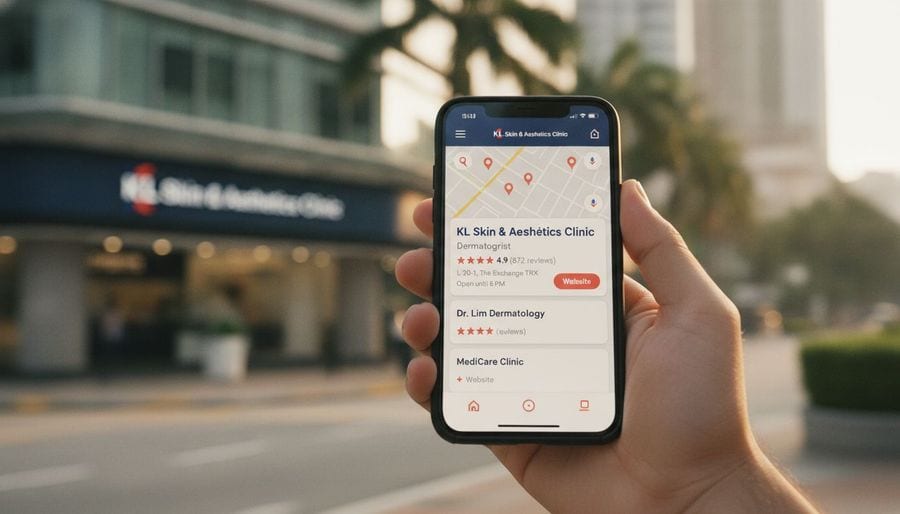
Old Result vs New Result: One KL Query, Two Games
Take a typical scenario — not a specific client, but the pattern any KL cafe or clinic manager will recognise. A customer searches "best cafe KL".
The old result type: a Map Pack of three cafes with star ratings, then ten blue links. Winning meant being one of the three pins. The customer compared ratings, tapped directions, walked in.
The new result type: a generated summary may sit above or alongside those listings — describing what makes a cafe worth visiting, naming a few options, linking to sources. The map is still there. But the summary has already framed the choice. If your cafe's signature dishes, halal status, opening hours and neighbourhood are stated clearly on your site and profile, a machine can describe you accurately. If they live only in your staff's heads and an Instagram caption, the summary will describe someone else.
This is where the fundamentals pay off twice. In our own local SEO work in KL, a Bukit Bintang cafe reached the #1 ranking for "Best Cafe KL" and 50+ related keywords, driving a 400% increase in foot traffic from organic search. A Mont Kiara luxury condo project saw a 280% increase in organic leads through local SEO and hyper-targeted content. Those results came from classic organic visibility — profile strength, reviews, content that matched real queries. They are exactly the assets an AI summary draws from. We are not claiming those numbers came from AI answers; we are saying the same groundwork now serves both surfaces.
Appearance is not traffic
No authoritative figure exists for click-through rates from AI Overviews or AI Mode, so treat any agency quoting one with suspicion. Measure what you can verify: calls, direction requests, bookings and walk-ins — and separately, whether AI answers name your business at all.
What This Means for Your Business: Five Moves Before 2026 Ends
The strategic reframe: local SEO is no longer a listing task. It is an entity-building programme — making your business the clearest, best-documented answer to the questions your neighbourhood asks. Here is the order we'd do it in.
- 1
Audit your NAP everywhere — profile, website, directories, socials. One canonical name, address and phone. Fix mismatches before anything else.
- 2
Complete the profile fully — hours (including public holidays), services, attributes, photos, service areas. Completeness is a stated ranking factor, not a nicety.
- 3
Build a review rhythm — ask every happy customer, respond to every review, never buy them. Steady and genuine beats big and stale.
- 4
Publish extractable answers — a page per core service and location question, each answering in the first two sentences, with hours, prices in RM and facts in plain text and tables. Cover the languages your customers actually search in — Malay, English and Mandarin demand rarely overlap.
- 5
Add LocalBusiness structured data and check indexing — make your identity machine-readable, confirm your key pages are indexed and snippet-eligible, then monitor whether AI answers cite you for your money queries.
The Investment Case: Visibility That Compounds
Paid ads stop the day you stop paying. A completed profile, a deep bench of genuine reviews, and a site full of clean, quotable answers keep working — across the map, the blue links and whatever AI surface Google ships next. That is the compounding asset. Every review you earn and every fact you publish raises the odds of being the business a machine names when your neighbourhood asks.
Rankings aren't the goal. Foot traffic is.
If you run a clinic, our SEO for healthcare and clinics practice covers the compliance-sensitive side of this in depth. For the full framework — profile, reviews, content, measurement — start with our Local SEO hub for Malaysia, and if you're weighing up partners, read why your KL clinic ranks on page two while a competitor owns the Map Pack and our look at how AI Overviews are reshaping KL rankings.
Is the Google Map Pack gone in Malaysia?
No. There is no evidence the three-listing Map Pack has been removed or replaced in Malaysian results. What has changed is that AI-generated answers can appear above and around local results, so the map is now one visibility surface among several rather than the only one worth optimising.
Do I need special AI markup or an llms.txt file to appear in AI Overviews?
No. Google Search Central states that a page must be indexed and eligible to show with a snippet to appear as a supporting link in AI Overviews or AI Mode, and that you don't need new machine-readable files, AI text files or special markup. Standard SEO fundamentals decide eligibility.
What actually improves my chances of being named in an AI answer about local businesses?
The verified levers are the classic local ones: a complete, accurate Google Business Profile; consistent name, address and phone across the web; a steady flow of genuine reviews; and website content that states hours, services and prices in RM in plain, extractable text. LocalBusiness structured data helps machines read your identity consistently.
Does appearing in an AI summary guarantee more customers?
No — appearance and traffic are different things, and no authoritative click-through figures for these features exist yet. Track verifiable outcomes (calls, direction requests, bookings, walk-ins) alongside whether AI answers mention your business, and treat any guaranteed-traffic claim with scepticism.
How much does local SEO cost in Malaysia?
It depends on your business size and competitive landscape. Hashmeta Malaysia's Local SEO packages start from RM1,500 per month; request a scoped quote for an exact figure rather than relying on generic market averages.
Hashmeta is an AI-powered SEO and digital marketing agency with teams in Singapore and Malaysia — 13+ years in search, 150+ clients, 500+ campaigns launched, and 50+ AI SEO/GEO deployments (past 6 months). Our local SEO work runs on expert-led AI: senior strategists direct, AI accelerates, human judgement on every move. Packages start from RM1,500/month, scoped to your business and competitive landscape. No one can guarantee rankings — but we can show you exactly where you stand today.
Find out what the AI already knows about your business
Our free SEO and AI-visibility audit checks your profile, your entity signals and whether AI answers name you for your money queries — before your competitors read this article.
Get your free auditSources
- Google Business Profile Help. Tips to improve your local ranking on Google. 2026. https://support.google.com/business/answer/7091?hl=en
- Google Search Central. AI features and your website. 2025. https://developers.google.com/search/docs/appearance/ai-features
- Google Search Central. Local Business structured data. 2025. https://developers.google.com/search/docs/appearance/structured-data/local-business
- Google (blog.google). AI Mode expands to new languages and locations. 2025. https://blog.google/products-and-platforms/products/search/ai-mode-expands-languages-locations/